
How Floating Docks Behave in Surge (And When They Win)
Floating docks ride rising water instead of fighting it, a real advantage, right up until the water outruns the guide piles. Here is the mechanism, both directions.
Key takeaways
- A floating dock's advantage in rising water is real: it rides the water instead of resisting it, so the uplift that tears decking off fixed docks simply is not the same problem.
- The governing variable is guide pile height. A floating dock is captured only as long as the water stays below the top of its guides: past that point it is an unrestrained buoyant object.
- Gangways are the weak geometry. They are designed to travel through a range of angles, and both rising water and the drawdown behind it can push them outside it.
- Connectors and shore attachments do almost no work in normal conditions and all of the work in a storm, which is why quietly corroding fasteners are found the hard way.
- Floating systems win on water-level swing and boarding; fixed structures win on strong current, heavy debris, and long absences with nobody inspecting.
There is a persistent belief on our canals that floating docks either survive storms better than fixed docks or considerably worse, depending on who you last talked to. Both camps are describing something real. Floating systems have a genuine structural advantage in rising water, and one specific, predictable way of failing that fixed docks do not share.
Here is the mechanism, without a sales pitch in either direction. We build both. For the water side of the story, start with how storm surge works on our canals; this page assumes it.
What does a floating dock actually do as water rises?
It goes up with it. That is the whole point, and it is worth understanding what that avoids.
A fixed dock is a rigid platform at a set elevation, and its framing and fasteners are engineered around load pressing downward. When water climbs above deck level, the load reverses: the deck wants to float, and every connection gets tested in the direction that was never the primary design case. That is the signature high-water failure of fixed docks: lifted or missing boards, fasteners pulled through, framing racked out of square while the pilings still stand.
A floating dock has no argument with rising water. It was always going to float. The uplift problem does not present the same way, because buoyancy is the deck’s job rather than its enemy. That advantage is real, and it is not marketing.
So what is the governing variable?
Guide pile height. Nearly everything about how a floating dock performs in a storm reduces to one question: did the water rise past the top of the guides?
A floating dock is not anchored down; it is held in position laterally. Guide piles, or a guide system mounted to a seawall: let the float travel freely up and down while preventing it from moving sideways or drifting off. The float rides the pile the way a collar rides a post.
That works beautifully right up to the moment the water level exceeds the top of the pile. At that point the float is no longer captured, a large, buoyant, unrestrained object on moving water, and where it goes is a matter of current and luck. It is why floating docks turn up in a neighbor’s yard, wedged against a bridge, or several lots down the canal.
We are not going to publish a guide height here, because the right one is a site question, your canal, your exposure, your elevation, the swing you actually see, and what your jurisdiction will permit. It belongs in the design conversation, not the recovery conversation. Our guide on how floating docks are anchored explains the systems.
What happens at the gangway and the connectors?
These are the two places a floating system stops being simple.
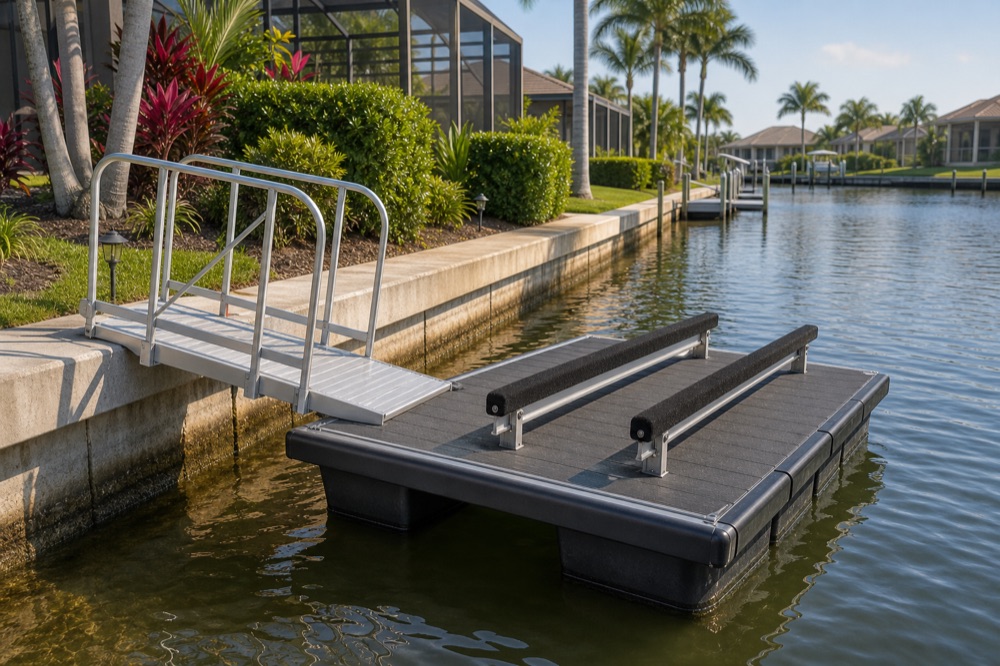
The gangway is the hinge between the fixed world and the moving one, designed to travel through a range of angles: hinged at the shore end, rolling or sliding at the float end. Inside that range it is elegant. Outside it, the geometry breaks down, the gangway binds, levers against its landing, or comes off the float end entirely. Rising water swings it toward flat and then past it; the drawdown behind a surge swings it the other way, sometimes steeply and fast.
The connectors are everywhere one float section meets another, and everywhere hardware ties the system to shore. A floating dock moves as an assembly, and assemblies concentrate load at their joints. In ordinary conditions those connections do almost nothing. In a storm they do all of it, and a quietly corroding fastener is the piece that finds out first.
Where do floating systems genuinely win, and where do fixed?
| Condition | Advantage | Why |
|---|---|---|
| Water rising above deck level | Floating | It rides rather than resists; the deck’s uplift problem largely disappears |
| Large tidal or seasonal water swing | Floating | Boarding height stays constant; nothing is loaded against the rise |
| Strong current moving through the canal | Fixed | A float presents a broad surface to moving water; pilings present very little |
| Heavy floating debris | Fixed | A piling-supported deck lets debris pass beneath instead of striking a hull-like surface |
| Water rising above the guide piles | Fixed | This is the floating system’s one decisive failure mode |
| Long absences with nobody inspecting | Fixed | Waterlogged floats and worn guide hardware need eyes on them to be caught |
Neither column makes a floating dock a good idea or a bad one. It makes it a choice with a known shape, which is the most useful thing an owner can have. For everyday trade-offs, see floating vs fixed docks in Florida.
What can you actually control before a storm?
The condition of the parts that decide the outcome, a shorter list than people expect.
- Guide hardware. Rollers, sleeves, brackets, and the fasteners holding them. This is the restraint system; treat it with that seriousness.
- The guide piles themselves. A guide pile is still a piling, with the same rot, marine borer, and looseness questions as any other on your property.
- Float condition. A waterlogged or cracked float sits lower and responds differently than the sections around it. When floats need replacing covers the warning signs.
- Connectors and shore attachments. Every joint, inspected rather than assumed.
- Everything loose. Furniture, dock boxes, ladders, mats, hoses. On a floating dock these go first.
- Removable sections, if your system has them and there is time to do it safely.
The season-by-season routine is in the floating docks hurricane playbook.
Florida Lifts & Docks designs, installs, and repairs floating docks across Cape Coral, Fort Myers, Naples, and Charlotte Harbor, our own crew, permitting in-house, since 2008. If you want the guides, guide piles, floats, gangway, and connectors evaluated honestly, that is a free on-site look. See our floating docks page or call (239) 397-3400.