
Jet Ski Lift Hurricane Playbook: Before, During & After the Storm
A PWC-specific storm plan for Southwest Florida: pre-season condition, the trailer-or-lift decision, securing the ski, and what to check before you run the lift again.
Key takeaways
- A PWC is the easiest thing on your dock to move, which makes trailering it inland the option most owners can actually pull off.
- If the ski stays on the lift, the storm position is a manufacturer question: piling-mounted, dock-mounted, seawall-mounted, and floating ports are engineered differently.
- Strap approach, cover removal, and lift position all vary by rig. Confirm them with your lift's manufacturer guidance and your insurer, not with the neighbor's setup.
- Kill the lift circuit at the breaker and bring the remote inside. After flooding, the circuit stays off until a licensed electrician clears it.
- Small hardware is what fails first on a PWC lift: cables, bunk brackets, and mount fasteners. Catch that in the spring, not with a system in the Gulf.
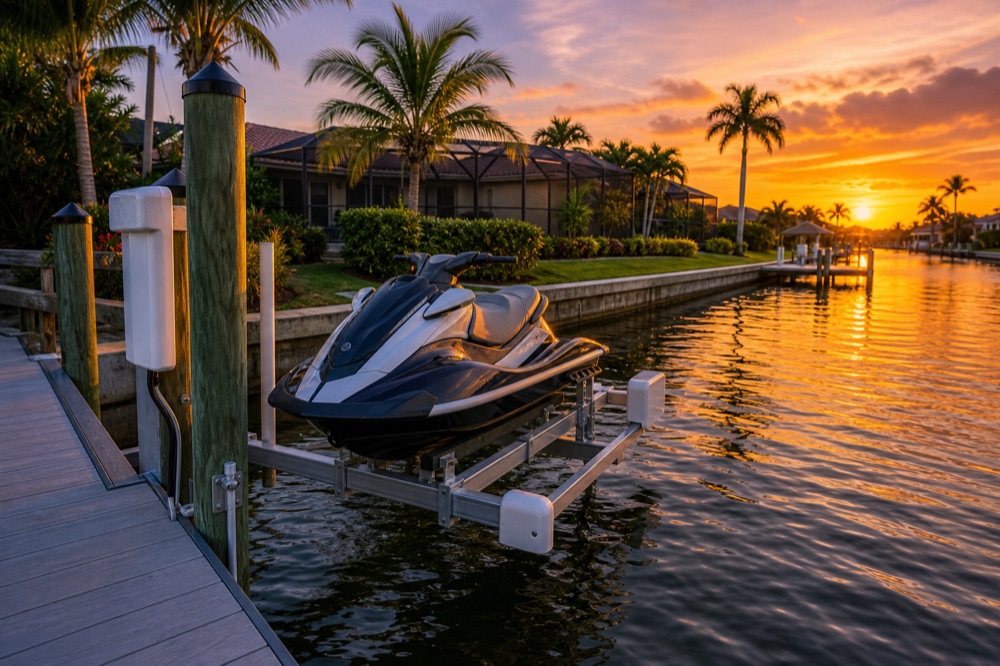
A personal watercraft is the smallest thing on your dock and the easiest to underestimate. It’s light, it sits low, and it’s usually the last item on the list when a system enters the Gulf, which is exactly why so many end up in the seawall rip-rap or three lots down the canal.
The upside is that a PWC is also the easiest thing on your waterfront to protect. Here’s the arc: pre-season condition, the decision you make when a storm is still days out, the final moves, and what to check afterward. As with any lift: the storm position and securing method for your rig come from your lift’s manufacturer, and coverage questions belong with your insurance agent.
What does a PWC lift need before hurricane season?
Small hardware fails first on these lifts, so the pre-season pass is mostly fasteners, cables, and the mount. Season here runs June 1 through November 30: do this walk in the spring, while crews still have availability.
- Cables and drive straps: fraying, rust bleed, flat spots, or a strand standing up.
- Bunk brackets and carpet, a small frame carrying a concentrated load, and worn bunks let the hull work around.
- The mount itself: piling bolts, dock through-bolts, or seawall anchors. Rust-jacked hardware is the failure nobody sees coming.
- The frame: flex, cracked welds, any bend that wasn’t there before.
- Motor and control box: corrosion, cracked housings, and how low the box sits.
- The piling or seawall it’s fixed to: cracks, movement, or soil loss behind the wall.
Our PWC lift maintenance guide covers the year-round version. Anything you find in April is routine; the same item found with a system three days out often isn’t fixable at all.
Trailer it or leave it on the lift: how do you decide?
Run three questions, and run them early.
- Can you get it on land? A PWC trailers behind almost anything and fits in a garage, a carport, or dry storage. Of everything on your dock, it’s the one asset most owners can genuinely remove from the water, and spots fill up as a system approaches.
- What does your lift’s manufacturer say? Whether the lift is rated to hold the ski in storm conditions, what position it should be in, and whether tie-downs are approved.
- What does your policy say? Coverage can read differently for a PWC on a lift, on a trailer at home, or in commercial storage. Ask your agent before the season starts.
| Setup | The storm question it raises | What to confirm first |
|---|---|---|
| Trailer + enclosed storage | Do you have a spot, and time to move it before roads get busy? | Where you’re parking it, and how coverage treats it there |
| Piling-mounted lift | How much travel does it have, and what position does the maker specify? | Manufacturer storm guidance for your exact model |
| Dock- or seawall-mounted lift | Limited travel, and a load path through the dock or wall | Manufacturer guidance, plus the condition of what it’s bolted to |
| Floating drive-on port | It can’t lift above anything, the job is staying put | Mooring hardware or pile guides, and room to ride a rising tide |
Where the water actually goes at your address is site-specific and worth understanding rather than guessing, the National Hurricane Center and your county’s emergency management office are the sources that matter, and the mechanism is in our storm surge guide. And the standing rule: an evacuation order for your zone outranks every item here.
How do you secure the ski if it stays on the lift?
Make the ski and the cradle behave as one piece, but get the method from your lift maker, not from a general rule.
Some manufacturers specify tie-downs from the ski to the lift frame; others don’t want that load on the frame at all. If straps are approved for your lift:
- Use marine-rated ratchet straps. Rope and bungees stretch, and a ski that can move will.
- Tension so the hull is seated on the bunks with no rock and no slop.
- Pad the straps wherever they cross the hull so they can’t chafe through.
- Re-check them after you’ve walked away and come back: straps settle.
Then strip the ski: cover off, cushions and mats off, hatches, seat, and glovebox closed against wind-driven rain, and nothing loose left on the dock. A PWC cover is a sail, and loose dock gear becomes somebody’s window. Our PWC hurricane prep checklist has the short-form version you can work through in an afternoon.
Does the lift power really need to be off?
Yes: off at the breaker panel, not just the switch at the dock. Then bring the remote or control box inside and dry.
Two minutes of work removes an entire category of storm problems: nothing can cycle the lift while you’re sheltering elsewhere, and if water reaches the motor there’s no live circuit sitting in it. After the water goes down, that rule doesn’t relax. The circuit stays off until a licensed electrician has inspected and cleared it, no drying it out and trying the switch, and no standing in water anywhere near a dock circuit.
What do you check after the storm?
Look first, from dry ground. The switch is the last step.
- Assume any downed line is live, and don’t walk out on a dock you can’t see is sound.
- From land, check whether the piling or mount moved, the frame is racked or bent, the cradle shifted or a cable jumped, and whether there’s a waterline mark on the motor or box.
- If the ski is still up there, leave it until the structure has been checked: bringing it down under power on a compromised lift is how a bad day gets worse.
- Photograph everything before you move anything. Wide and close, several angles. What your carrier wants varies by policy, so ask your agent.
- Have the electrical cleared by an electrician and the structure looked at before the lift carries weight again. The full order is in post-storm lift triage, and the bigger-boat version is the boat lift hurricane playbook.
When to call us: once you’re safe and the documentation is done. Florida Lifts & Docks has installed and repaired PWC lifts across Cape Coral, Fort Myers, Naples, and the rest of the coast since 2008, with our own crew and permitting handled in house. We’ll look at the lift, the mount, and the piling or seawall behind it and put a written repair-or-replace estimate in your hands, free and on site. See our jet ski lifts page or call (239) 397-3400.