
Tiki Thatch After the Blow: Repair, Rethatch or Rebuild
Thatch is designed to be the part that gives. How to tell whether you lost a roof or a structure, and why the ugliest tiki on the canal is often the soundest.
Key takeaways
- Thatch is sacrificial by design: losing some of it in a storm is the roof doing its job, not failing at it.
- The question that matters is never the thatch. It's the posts, the connections, and whether the frame moved.
- A tiki that looks destroyed and a tiki that is destroyed are frequently not the same hut.
- Patch, partial rethatch, and full rethatch are genuinely different jobs: matching weathered thatch is the hard part, not the thatching.
- If the posts shifted or the frame racked, the roof is the least of it, and no amount of new thatch fixes it.
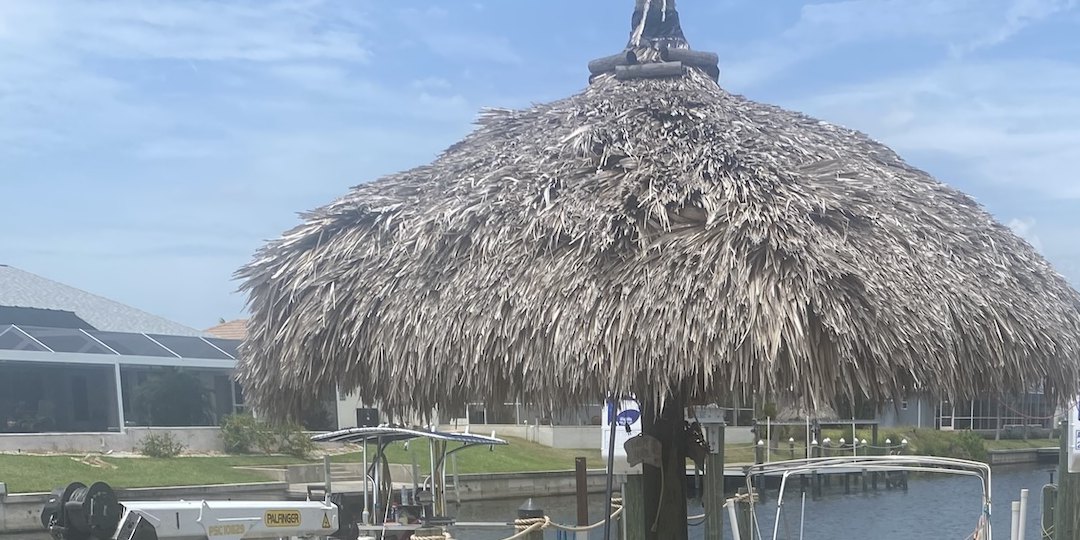
After a storm, a tiki hut is the most alarming-looking thing on a waterfront lot. Thatch goes everywhere. What’s left looks thin and ragged. Owners take one look and assume they’re starting over.
Usually they aren’t. Thatch is supposed to do that.
Why does thatch come off so easily?
Because a thatch roof isn’t trying to be a sealed structure. It’s layered natural material designed to shed wind and water rather than resist them, and when it gives up material in a hard blow, it’s dumping load instead of transferring it down into the frame.
That’s the design. A roof that held onto everything would be handing all that force to the rafters, the ring beam, and the posts, and those are the expensive parts. The thatch coming off is the cheap part protecting the expensive parts.
So the sight of a stripped-looking tiki is genuinely not diagnostic. It might be a hut that did its job perfectly.
What actually matters, then?
Everything underneath. Work from the ground up, in this order.
The posts. Push on each one. Look where it meets the deck or the ground for movement, splitting, or hardware that’s pulled. If your tiki sits on a dock, the posts share the dock’s fate, so anything in post-storm dock triage about pilings and connections applies here too.
The frame’s square. Sight the hut from a corner. A structure that has racked: pushed out of square into a lean: has had load go through it sideways, and no amount of new thatch corrects that.
The connections. Every place two members meet is a place to look for fresh gaps, bright unweathered wood, crushed fibers around bolts, and fasteners that have backed out or elongated their holes. This is where a storm leaves its real signature.
Then the thatch. By the time you get here, you generally already know whether you have a roof problem or a structure problem.
Repair, rethatch, or rebuild?
Three genuinely different jobs.
| What you have | What it usually is |
|---|---|
| Sound frame, one damaged face or section | A patch or partial rethatch |
| Sound frame, thatch thin and tired all over | A full rethatch, the storm just set the timing |
| Frame racked, posts moved, connections opened | A structural repair or rebuild; the roof is secondary |
| Posts or dock beneath compromised | Fix what’s underneath first, always |
The wrinkle on patching is aesthetic, not structural. New thatch is bright and dense; weathered thatch is grey and thin. Put them side by side and the repair announces itself for a long time. That’s why a partial rethatch of a whole face often looks better than a smaller, cheaper patch in the middle of one, and it’s worth knowing before you choose the smaller job.
If your hut was already approaching a rethatch, the storm mostly just made the decision for you. Our guide on how often to rethatch a tiki roof covers what drives that cycle, and natural palm versus synthetic thatch is the right read if you’re rethinking the material while it’s open anyway.
What about the stuff you can’t see from the ground?
Two things worth a closer look:
The ring beam and rafter connections at the peak. This is where the roof’s geometry is held together, and it takes the most torque in a blow. It’s also the hardest part to see from below.
Water that got in and stayed. Thatch that was compressed and soaked, sitting on framing, holds moisture against wood far longer than anyone expects. A hut that dries out slowly under a damaged roof can develop a rot problem months after the storm that had nothing to do with the wind.
Neither of these shows up in a walk-around. Both show up in an inspection.
The honest summary
A tiki hut that lost thatch and kept its frame is a good outcome, not a bad one. Rethatching is a known, contained job. What you don’t want to do is put a beautiful new roof on a frame that moved: that’s spending real money to hide a structural problem, and the structure will still be wrong underneath.
So check the posts, check the square, check the connections, and let the thatch be the last thing you worry about. Ugly and sound beats handsome and shifted every time.
Before any of that, though: the tiki hut storm playbook covers what to do before the next one, which is a much cheaper conversation.
If yours took a hit and you want someone to tell you honestly whether it’s a roof or a structure, we’ll come look at it. Free on-site estimate: call (239) 397-3400.