
Buying Waterfront on Marco Island: What to Check Before You Close
Two questions decide how a Marco Island waterfront purchase ages: which authority actually governs the parcel, and what condition the structures past the seawall are really in. Both are answerable before closing.
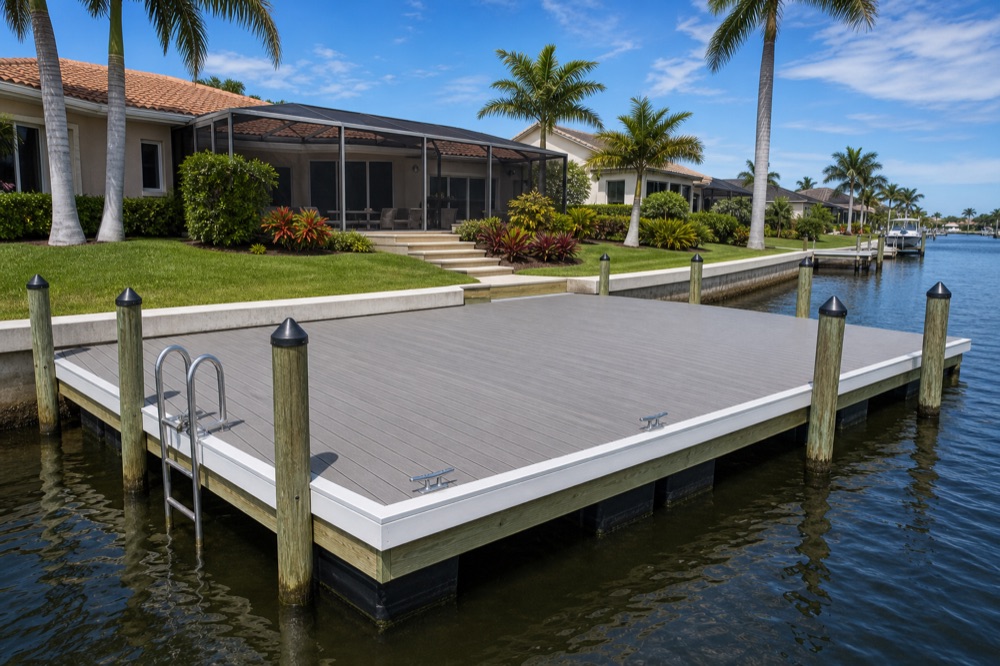
- Who holds the file
- Marco Island issues its own building permits, so the permit history sits with the city
- First question
- Whether the parcel is inside the city limits at all: mail is not jurisdiction
- Ask twice
- Whether a permit exists, and whether it was ever closed out
- Highest consequence
- The seawall, most of what goes wrong is behind it or below the waterline
- Out of scope
- A standard home inspection generally stops at the shoreline
Key takeaways
- A standard home inspection generally stops at the shoreline. The dock, the lift, the pilings and the seawall are usually outside its scope, and they are the expensive part of a waterfront purchase.
- Marco Island is its own incorporated city and issues its own building permits, so the permit history you want to see sits with the city, but a Marco Island mailing address is not proof the parcel is inside the city limits.
- Ask whether each permit was closed, not just whether one exists. A permit that opened and a permit that finished are different animals, and only one of them transfers cleanly.
- The seawall is the highest-consequence unknown on the lot and the best at hiding its condition, because most of what goes wrong happens behind the wall or below the waterline.
- Everything found inside the inspection window is negotiable, a credit, a repair, a price, a walk. Everything found after closing is yours, at full retail, on your own calendar.
A waterfront purchase on Marco Island gets inspected like a house and used like a boat slip. The house half is well covered, a licensed inspector, a report, a repair addendum, a timeline. The water half usually is not, and that is where the expensive surprises sit waiting.
Two of those surprises come up here more than anywhere else we work. The parcel may not be governed by the authority you assume it is, and the structures past the seawall may have nothing on paper standing behind them. Both are answerable in the inspection window. Both get considerably harder to fix after closing.
Which authority actually has this parcel?
The City of Marco Island, if the parcel sits inside the city limits. A Marco Island mailing address is not proof that it does.
Marco Island is its own incorporated city, with its own building department, its own permit application forms, and its own online permitting portal. That is a genuine structural difference from a waterfront neighborhood sitting inside someone else’s city, and for a buyer it decides three practical things: who holds the permit history you are about to ask for, who you would file with for anything you want to change, and whose rulebook governs the dock you are inheriting.
The wrinkle worth knowing before you start making calls is that not every address with Marco Island mail is inside the city. Isles of Capri, just north, is unincorporated Collier County. Confirm which authority has jurisdiction over the specific parcel before you request anything or assume anything. Dock permits on Marco Island maps out who signs off on what and in what order, including the deed-restriction warning the city prints on its own marine application, which belongs in the same week as the title work rather than the week you start drawing a dock.
What do you ask for on paper?
A permit for every structure past the seawall, and then a second question about each one.
The list is short and the seller either has it or does not: the dock, the boat lift, the seawall, and anything else standing in or over the water. On Marco the seawall is a separate permit from the dock and lift; seawall permits here have their own requirements, so “we permitted the dock” is not an answer about the wall.
The second question is the one people skip. Was the permit closed? A permit that opened and a permit that finished are different animals, and on Marco the finish line is a paperwork event rather than a last board going down. Ask for the closeout, not just the number. Properly permitted work has a trail behind it, the state and federal approvals that applied, then the city, rather than a single card in a drawer.
If the paperwork does not exist, that is information rather than a dealbreaker, and what unpermitted work means when you buy or sell covers where it actually bites. What does not work is the sentence every buyer eventually hears: it was here when we bought it. The problem transfers with the deed.
What do you actually look at past the seawall?
The four things that carry load, in the order they cost you money:
- The seawall. The highest-consequence unknown on the lot and the best at hiding its condition, because most of what goes wrong happens behind the wall or below the waterline. Walk the yard behind it and look for soft ground, small dips and holes near the cap. Look at the cap itself for cracks working through, and at the weep holes for whether they are doing anything at all. The signs a seawall is failing are worth reading before the walkthrough, not after.
- The pilings. Push on them. A piling that moves is the single finding that should change your plans that day. Check the waterline band and just below it, where marine borers do their work, and note which pilings are wrapped and which are not.
- The framing and the fasteners. Salt takes the connections long before it takes the timber they hold together. Get your head under the deck if you can. Fresh decking over tired framing is the most common cosmetic cover on this coast and it hides exactly the thing you are trying to see.
- The lift. Cables, bunks and cradle alignment, the motor and gearbox, and the electrical, a lift brings a circuit out over the water, and on Marco the city’s application asks specifically where the ground-fault protection lives, so it is fair to ask the seller the same thing. Boat lift permits on Marco Island covers that side.
The waterfront inspection checklist is the long-form version of this list, and it is written to be carried around a dock rather than read at a desk.
One more diligence question sits outside that list and belongs before the offer rather than after it: which crossings stand between the canal and open water, because they decide the boat the house can keep. The Marco Island canal and water guide covers how to check it properly.
How do you read what you are being told?
Carefully, because most of what a buyer hears about the water side is honest, secondhand and wrong.
Sellers rarely mislead on marine structures. They repeat what they were told when they bought, which was itself a summary of what somebody said years earlier, and none of it has been checked since. So separate the three kinds of statement you will get. A document, a permit number, a closeout, a survey: is verifiable and worth the phone call. An observation: “we have never had a problem with the wall”: is true and tells you nothing about what is behind it. A conclusion: “the dock is in great shape”: is somebody’s opinion wearing a fact’s clothing.
The practical filter is to ask what would have to be true. If the dock is fine, someone has been under it. If the lift is fine, someone has looked at the cables recently. If the seawall is fine, the ground behind it should show it. None of that is adversarial; it is just the difference between a purchase you priced and a purchase you inherited.
Where is the leverage?
Before closing, and only before closing.
Everything found in diligence is negotiable, a credit, a repair, a price, a walk. Everything found afterward is yours, at full retail, on your own calendar. That asymmetry is the entire argument for spending an hour of somebody’s time on the structures nobody else is looking at.
The practical version: have the marine structures looked at by someone who builds them, inside the inspection window, and get a straight read on which items are maintenance, which are repair, and which are replacement. What fails on Marco docks covers the patterns we see here specifically, and where that line usually gets drawn.
We do that walk for buyers regularly, on Marco Island water and across Southwest Florida, and we will tell you when the honest answer is that the dock is fine. On the water since 2008, licensed and insured. Free on-site estimate: call (239) 397-3400.
The rest of our Marco Island library: permits, water, storms, and what we actually see on these docks.