
Boat Lifts in Marco Island: Canals, Depths & the Right Setup
On Marco the ceiling is overhead, not underneath. What your route out will accept sets the class of boat, and only then does the lift conversation start.
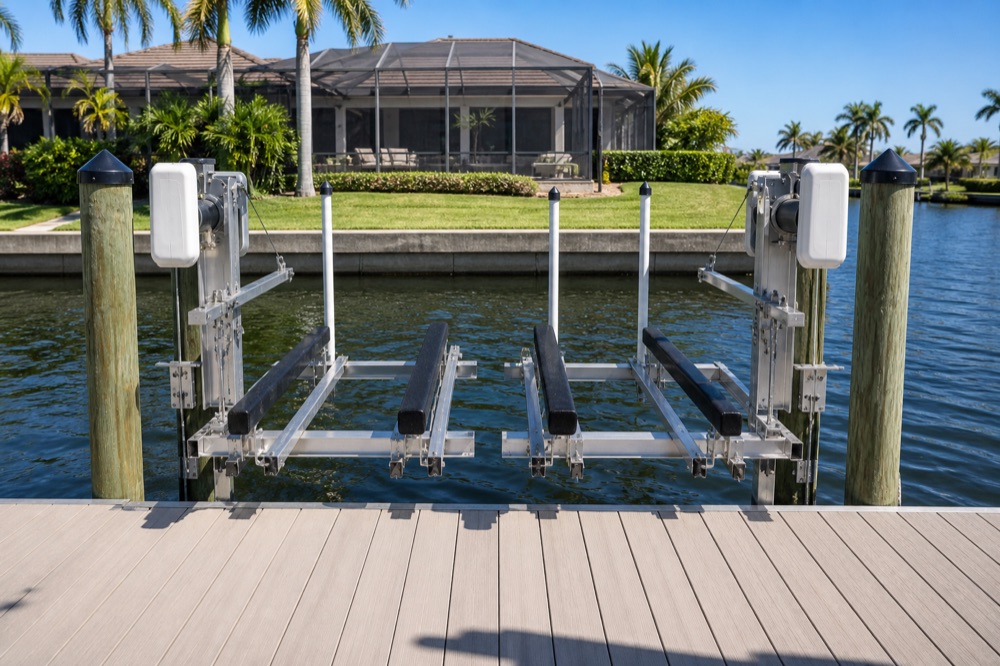
- Where sizing starts here
- With the route out, not with the boat
- The number that sizes it
- Loaded weight: hull, engines, fuel, water, batteries and what lives aboard
- Capacity margin
- 20–30% over that loaded number
- What it stands on
- Dock pilings, or a wall that can take a load which comes and goes
- Permitting
- Through the City of Marco Island, with state and federal approvals where they apply
Key takeaways
- The specification here runs route, then boat, then lift. The crossings on the way out to the passes set a limit no amount of capacity solves.
- Loaded weight is the sizing number: hull, engine package, a full tank, fresh water, batteries and everything that quietly moved aboard. Fuel alone runs about 6 pounds per gallon.
- Carry 20–30% over that loaded figure. Owners change boats far more often than they change lifts, and margin is what lets one survive the next.
- The island's interior water is Idle Speed / No Wake throughout, so what wears a Marco lift out is mostly its own cycling rather than the weather.
- Before anyone picks a model, somebody has to answer what will carry it: pilings driven for the job, or a wall now being asked to take a load that comes and goes.
Ask a lift company what size you need and you’ll get a weight question back. On Marco Island that’s the second question, and asking it first is how owners end up with a well-specified lift under a boat that can’t get home.
The ceiling here is overhead.
Why does the route come before the boat?
Because Marco’s interior water runs under bridges, and what clears one crossing tells you nothing about the next.
That makes the run from your slip out to the passes a genuine limit on what you can own, and it’s the one limit no amount of capacity solves. The city publishes a clearance survey and then tells boaters not to lean on it, so the honest instruction is to settle the question yourself: against the posted boards and your own measurement at high water. The Marco Island canal and water guide works through that properly, crossing by crossing.
What that does to a lift specification is straightforward. The route decides the class of boat, the boat decides the loaded weight, and the loaded weight decides the machine. Run it in that direction and everything downstream is arithmetic; run it backwards and you’ve bought capacity for a boat that can’t reach your canal.
Does it matter where on the island your slip sits?
Less about the rating, more about whether you’ll enjoy using the thing.
Interior canal water spends most of its life still. The boat sits where you leave it, coming alongside is unhurried, and what shapes your actual day is boarding, how the cradle carries the hull, and getting under way when the water is down. Frontage on or near the river and the passes is a different animal, more open water ahead of you, wind with a longer run at it, a boat that moves at the slip on a blustery week, which makes how the hull is held, and how hard the hardware works, the live questions instead.
Width is the other half, and here Marco geometry gets specific. Plenty of the interior canals don’t have the room beside a dock for a conventional four-post lift, which pushes the project onto the wall. A lift mounted to a seawall with no dock is a legitimate and common answer here. It just moves the structural question from the pilings to the wall, which is worth asking before you fall for a model.
What does an island-wide idle-speed rule change?
It changes how a lift here gets loaded.
Marco’s interior is Idle Speed / No Wake throughout: waterways, canals and bays alike. In an open-water market, part of what a cradle and bunks have to tolerate is a boat being shoved about by passing traffic while you’re putting it away. Here that’s the exception rather than the standing condition, and you drive on in flat water most times you do it.
It also decides where the money is best spent. When the water isn’t fighting you, what wears a Marco lift out is its own cycling rather than the weather, an argument for spending on the drive, the cables and the parts doing the repeating, and against the instinct that the answer to any worry is a bigger lift.
How do you land on the right capacity?
By building the number up from the boat you own rather than reading it off a sheet.
A published weight is a hull as the factory shipped it. What your lift picks up is that hull plus the engine package, a full tank, fresh water, batteries and the accumulated cargo of ownership, the anchor, the cooler, the rods, the second set of everything that moved aboard and never left. Fuel alone runs about 6 pounds per gallon, which makes tank size a line item, not a footnote. What size boat lift do I need runs that arithmetic end to end.
On top of the loaded figure, carry 20–30%. Part of that is the wear argument above; the rest is that owners change boats considerably more often than they change lifts. Your route has already narrowed the class of boat you can keep here, so the next one will probably land near this one, and margin bought today is what stops a lift being re-specified alongside it.
Then the question nobody asks until the quote arrives: what carries all of it. On a dock-mounted lift, the pilings, their size, their spacing, how they were driven. On a wall-mounted lift, a seawall built to hold your yard back against a steady push and now asked to take a load that comes and goes every time you do. On a lot of Marco jobs the first visit is spent on those, before anyone opens a catalogue. The Marco Island seawall and shoreline guide covers what holds up and what tends to go first.
What does it cost?
The published ranges, in full, so you can plan before anyone visits:
- Jet ski lifts: $3,000–$5,000
- 7,000–10,000 lb: $8,000–$13,500
- 16,000 lb: $14,000–$19,000
- 24,000 lb and up, from $22,000
- Canopy: add $14,000–$22,000
Where a Marco job lands inside those comes down to a short list: whether your pilings can be reused or new ones have to be driven, how a crew and its materials physically reach your slip, how far power has to travel, and what is already standing at the water’s edge. Our Southwest Florida boat lift cost guide itemises the components.
We price on site, and we’re stubborn about it: a figure produced before somebody has stood on your dock is arithmetic performed on assumptions, and assumptions tend to flatter whoever makes them.
What’s left to settle?
Three things, and not one of them is a model number.
Permits. Marco Island is its own city with its own building department, and a lift is declared on the city’s marine application rather than filed on its own. The electrical scope belongs to a licensed trade, and the city asks a pointed question about it; boat lift permits in Marco Island covers that ground. We handle the filing.
Install. With the permit in hand and materials staged, the lift itself is typically a day or two on-site. The approvals, the ordering, and any piling work that comes first are usually where the calendar actually goes.
Storms. We don’t set the storm position of your lift. The manufacturer specifies it and your insurance policy may add a condition of its own, and between those two there’s no room left for a contractor’s opinion, including ours.
Come to us with the route settled, the loaded weight worked out, and an honest account of how you use the boat, and the rest is measurement we take ourselves. We’ll look at the pilings and the wall and tell you what the right boat lift is, and say plainly if what’s under the dock has to be dealt with first.
Free on-site estimates across Marco Island. Call (239) 397-3400.
The rest of our Marco Island library: permits, water, storms, and what we actually see on these docks.