
Dock & Lift Repair on Marco Island: What Actually Fails
The same handful of failures, over and over, on an island quiet enough by rule that the wear on a dock is telling you something specific.
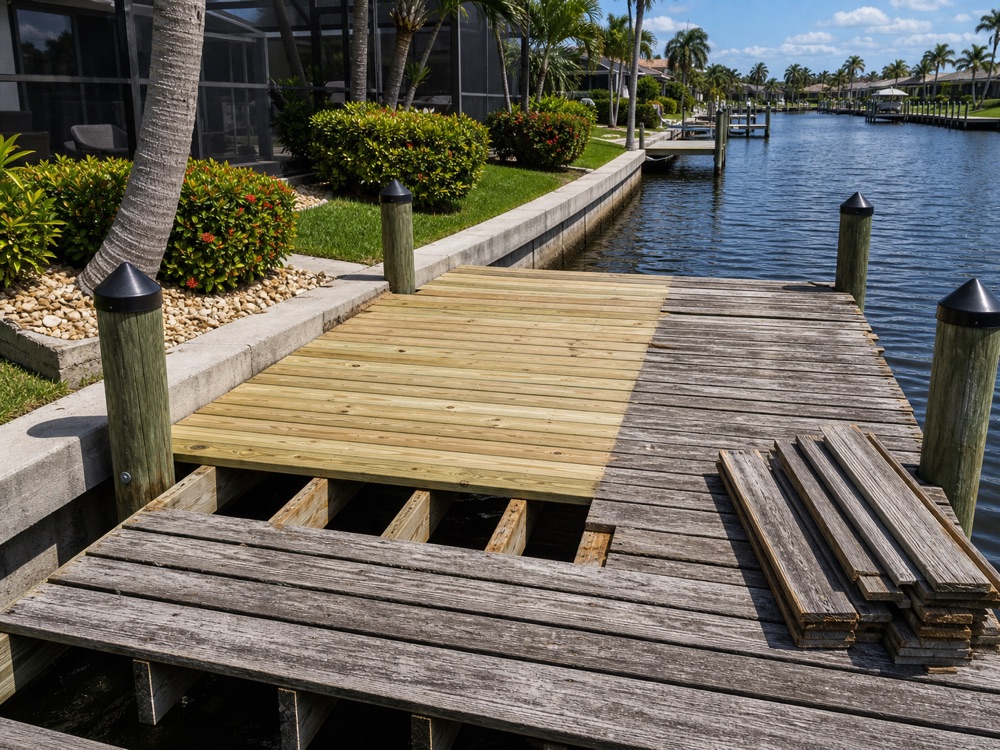
- Goes first
- Connections and fasteners, long before the timber they hold together
- Most urgent
- A piling that moves when you push it
- The island factor
- Idle Speed / No Wake everywhere, so wake fatigue on an interior dock is worth chasing
- On the city's form
- Re-decking an existing dock is declared work, not maintenance
- During the job
- A framing inspection, and no splicing unsupported framing without sealed engineering
Key takeaways
- Salt takes the connections first. Fasteners, brackets and hardware fail well before the timber or composite they are holding together.
- A piling that moves when you push on it is the one finding that should change your plans the same day.
- Idle Speed / No Wake applies to every interior waterway, canal and bay on Marco, so wake fatigue on an interior dock: loosened fasteners, worked through-bolts, a lift drifting out of alignment: is a symptom with a cause worth finding, not the cost of the address.
- Re-decking an existing dock is its own declared line on the city's marine permit application. On this island it is permitted work, not a weekend.
- The city requires a framing inspection to verify fasteners are adequate, and unsupported framing cannot be spliced without signed, sealed and dated engineering detailing the repair.
Marine repair work on Marco Island is not exotic. It is the same short list of failures we see across Southwest Florida, in roughly the same order, driven by the same three things: salt, water movement, and load that arrived faster than the structure was designed for.
What the island adds is a useful piece of context and a couple of procedural facts. The context is that the water here is quiet by rule, so wear that looks like wake fatigue deserves a second look. The procedural facts show up when you go to fix something, because on Marco, repair work is declared work.
What goes first?
The connections, nearly always.
Fasteners, brackets, joist hangers, bolts, lift hardware, the steel that holds everything else together loses section to salt long before the timber or composite does. The failure is quiet and it happens from underneath, which is why a deck can look immaculate from above while the thing carrying it is halfway gone. Any honest look at a dock involves getting under the edge of it with a light.
Two related patterns worth naming:
- Mixed metals. Wherever two dissimilar metals touch in a wet, salty environment, one of them is being sacrificed. It shows up at hardware transitions, at lift components, and at anything somebody replaced in a hurry with what was in the truck.
- Fresh boards over tired framing. New decking laid over old stringers is the cosmetic fix we see most often on this coast, and it hides precisely the layer you needed to see. Replacing rotted dock boards covers when re-decking is genuinely the right call and when it is a cover.
What is most urgent?
Piling movement. Everything else can wait for a quote.
A piling that rocks, leans, or feels soft at the waterline is not a maintenance item. It is the foundation reporting a problem. Load redistributes onto neighboring pilings, which accelerates the next failure, and the structure above stops behaving the way it was designed to. Check the band at and just below the waterline, where marine borers do their work, and note which pilings are wrapped and which never were. Marine borers and piling wrapping covers what is actually happening down there.
What does immersion do?
More than people expect, and mostly to things other than the boards.
After water has been over a deck: storm, surge, or a king tide with wind behind it, the decking is the least of it. Look for fasteners backing out as wet framing swells and shrinks, hardware that has started weeping rust stains onto the boards, and any joint that has opened up. Composite decking survives immersion far better than the framing under it, which is exactly why the deck-looks-fine reflex is dangerous.
Dock and lift electrical stays dead until a licensed electrician has cleared it. Not until it looks normal, and not until something works when you try it. That rule does not bend.
Does an idle-speed island wear docks out differently?
It changes what the wear is telling you.
Idle Speed / No Wake applies to all of Marco Island’s interior waterways, canals and bays, with idle speed defined as the minimum speed needed to maintain steerage. What that rule does to the evidence a shoreline gives you is the seawall guide’s argument, and it makes that case better than we would repeat it here.
For a dock, the consequence is narrower and more practical. Wake loading does not usually break something outright; it works. Fasteners loosen, through-bolts start moving in their holes, a lift creeps out of alignment between services, and a floating structure chews at its guides. On quiet interior water those are symptoms worth chasing to a cause rather than re-tightening every spring, because the same fix keeps coming back until you know what is loosening it.
Exposure is not uniform across the island, though. Frontage nearer the river or one of the passes has real open water in front of it and a longer run for the wind, and that shows up in fastener wear, in how hard the wall behind the dock is working, and in what a floating structure does on a bad afternoon. Canal fetch and waves explains the mechanism; the Marco Island seawall and shoreline guide picks it up from the wall side.
What fails on the lift?
Cables, alignment and the things nobody looks at.
Cables are the most-ignored wear item on the water and they fail in a way that damages the boat; the warning signs are readable months ahead if anyone is reading them. Beyond that: bunks and cradle alignment drifting out of true, gearboxes and motors that have been running dry, pilings the lift is bolted to moving independently of each other, and corrosion at every dissimilar-metal junction.
Lifts also fail from being right for the last boat. A hull that grew between purchases is a load problem, not a maintenance problem, and no amount of servicing fixes it.
What does Marco add to the actual fix?
Three things worth knowing before anybody schedules a crew.
Re-decking is declared work. The city’s marine permit application carries re-decking an existing dock as its own line, alongside a new dock, lifts, davits and mooring pilings. Permitting a repair here is not an unusual imposition. It is how the form is built. Dock permits on Marco Island covers the whole path.
There is an inspection during the work. The city requires a framing inspection to verify that fasteners are adequate and sound engineering practices were followed, and it carries a companion rule with teeth: unsupported framing cannot be spliced without signed, sealed and dated engineering detailing the repair. Nobody quietly joins two short members and keeps going.
Access and staging are part of the plan. Marco lots get worked from the water and from a driveway, and the city expects to be told where a job will put its materials and load its equipment before it approves one, a neighboring vacant residential lot is not an available answer. On a tight street that is a scheduling conversation, not an afterthought.
When should you actually call?
When something moves, when something is weeping rust, when a cable looks wrong, or when you have been thinking about it for a season.
Small marine repairs stay small for a shorter time than owners expect, because everything on this list accelerates the next item on it. And after a storm the sequence changes; post-storm dock triage and the rest of the Storm Center cover that properly.
We repair and rebuild docks, lifts, pilings and seawalls on Marco Island water, and we will tell you when the answer is that nothing needs doing yet. On the water since 2008, licensed and insured. Free on-site estimate: (239) 397-3400.
The rest of our Marco Island library: permits, water, storms, and what we actually see on these docks.