
Rebuilding Stronger: Material Upgrades Worth Making
You are already paying for the access, the mobilization and the permit. That makes a rebuild the one moment when the upgrades that matter cost the least, here is which ones earn their place.
Key takeaways
- A rebuild is the cheapest upgrade window you will ever get, because the access, the mobilization, the permit and the open framing are already paid for. The same upgrade bought separately later means paying for all of that a second time.
- Rebuilding to exactly what was there is a default, not a decision. It is often the right answer, but it should be one you actually made.
- Your own wreckage is the best specification document on the job. Walk it before it is hauled off and look at where it let go, because that is where the next storm will start.
- Connections fail long before lumber does. Hardware specified as one compatible system, with cut ends and drilled holes treated as coating breaks, buys more real storm performance than almost anything else on the list.
- Nothing on the water is hurricane-proof. The honest goal is fewer failure points, failures in cheaper places, and a structure that comes back in a shorter job.
There is a moment in every storm rebuild where somebody asks what it would take to put it back exactly as it was. It is a fair question, and often the answer is the right one. But “the same as before” is a default rather than a decision, and the moment you are standing in is the one moment when changing your mind is cheap.
That is the whole argument here. Not that you should gold-plate a dock: that upgrades made while a structure is open are bought at a fraction of what the same change costs later as its own project.
Why is a rebuild the cheapest time to upgrade?
Because the expensive part of marine work is rarely the material. It is getting there and getting in.
Mobilizing crew and equipment to your canal, staging on the lawn, working from the water where access demands it, permitting the job, opening the structure up, that is the bulk of what any dock or seawall project costs, and on a rebuild you pay it regardless. Better hardware, different decking, wrapped pilings, drainage put in properly behind a wall: each is a material and labor difference layered onto work that is happening anyway.
Buy the same upgrade separately later and you pay for the access, the mobilization and often the permitting a second time, for a much smaller piece of work. The order the job follows is covered in rebuild order after a storm: shoreline, pilings, deck, then power, and every phase has an upgrade decision inside it.
What does your own wreckage tell you?
More than any article can, including this one. Before the damaged material is hauled off, walk it.
You are looking for where it let go. Sound boards lying loose with the fasteners still in them says the connection failed, not the lumber. A bracket torn from one member while still bolted to the other says the same. Pilings that moved rather than broke point at the ground and the embedment. Decking that came off in sheets points at the fastening pattern. Corrosion concentrated at cut ends and drilled holes says the coating was interrupted and salt found the opening.
That is a specification nobody had to write. Whatever failed first is where the upgrade money goes, because the next storm starts in the same place.
Which upgrades earn their place while it is open?
The ones aimed at where things actually break. Roughly in the order we see them fail:
| Where storms break things | The upgrade while it is open | The honest limit |
|---|---|---|
| Connections and fasteners | Hardware specified as one compatible metal system, with cut ends and drilled holes treated as coating breaks | Salt reaches everything eventually; connections you can inspect matter as much as their metal |
| The splash zone on pilings | Wrapping, and a piling material chosen for the water rather than the line item | Wrapping protects what it covers; above and below it still needs eyes |
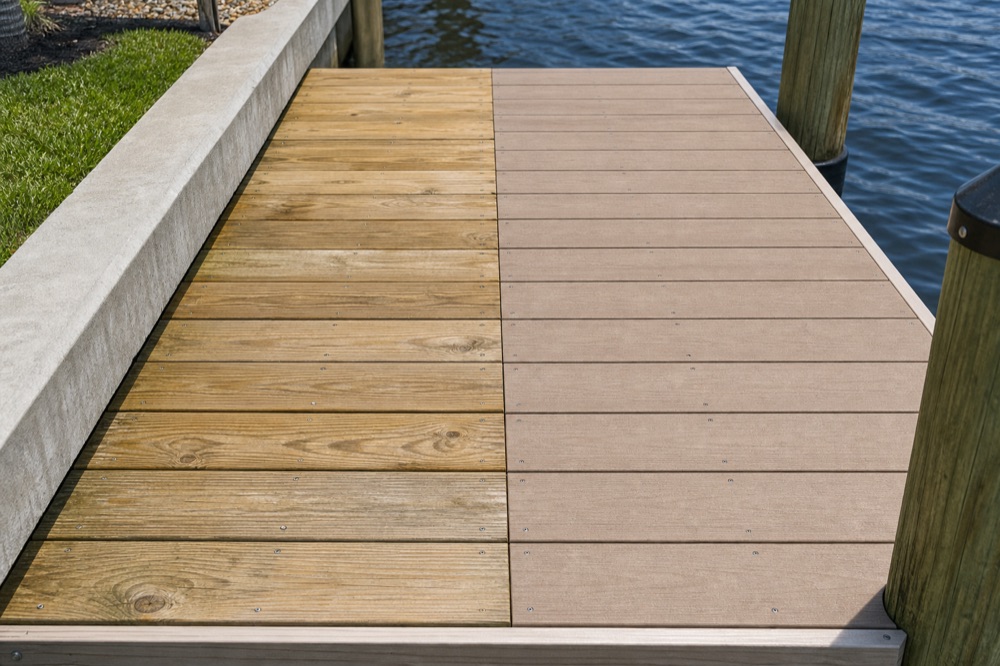
| Decking after immersion | Material and a fastening method that let one damaged board come out without dismantling a section | No decking keeps a deck dry; this is about recovery, not immunity |
| Lift hardware | Cables, sheaves, brackets, bunks and anodes replaced as a set rather than piecemeal | A lift is only as good as the pilings holding it |
| The ground behind and beneath | Drainage, working weep holes, backfill placed and compacted, rip-rap at the toe | A seawall is not a flood barrier |
| Dock and lift power | Dedicated, labeled circuits and a disconnect you can find in the dark | Licensed electrician work, new and after any flooding |
Piling wrapping targets the splash and tidal band, where wet-dry cycling, salt, sun and marine borers concentrate, the mechanism is in our guide to marine borers and piling wrapping. Decking is worth choosing on how it behaves wet and how easily one board comes out, not on how it photographs.
Design-time levers that exist mainly on a new build: deck elevation, thru-flow decking, embedment set for your site: belong to building for the next storm. On a rebuild some are still available to you, and it is worth asking which.
What about the ground rather than the structure?
It is the half that gets skipped, and where the slow failures live. Pilings sit in soil that storms rearrange.
Scour pulls material from the toe of a wall and from around pilings without announcing itself, the wall looks fine while the ground behind it quietly goes somewhere. Clogged weep holes trap water pressure behind a wall designed to release it. Backfill dumped rather than placed and compacted settles into a void you find later as a soft spot in the lawn.
A rebuild is the point at which all of it is reachable: drainage corrected, weep holes cleared, backfill done properly, and rip-rap placed at the toe where the wall needs protecting. None of it shows in a photograph of the finished dock, which is why it gets deferred.
So what does “stronger” actually mean?
Nothing on the water is hurricane-proof. Not ours, not anybody’s, and we do not use the word, and you should not accept a storm-performance claim that cannot be explained as a mechanism.
What these choices genuinely buy is a higher threshold before damage starts, fewer places for failure to begin, damage landing in the cheap replaceable parts instead of the framing and the pilings, and, the one owners feel most, a faster recovery. A dock that comes through needing decking replaced is a different phone call from one with pilings displaced and a wall undermined.
Florida Lifts & Docks has been on the water since 2008, licensed and insured, with our own crew rather than subcontractors and permitting handled in house. If you are rebuilding, we will lay these trade-offs against your site and put an itemized scope in your hands, free and on site. The full Storm Center covers the rest of the arc. See our custom docks page or call (239) 397-3400.