
Hurricane Prep for Bonita Springs Waterfront Homes
On the Imperial River and the canals off it, the water can arrive from two directions: off the bay, and down the river from rain that fell miles inland.
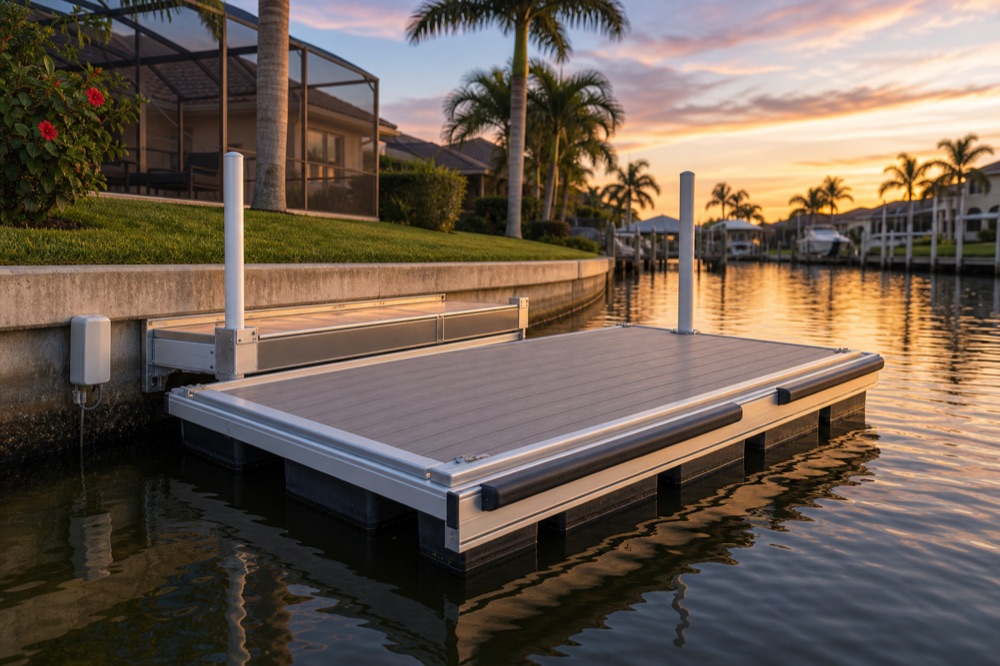
- Two water risks
- Coastal surge, and the river rising from inland rain
- Sheet flow
- Runoff from rain that fell miles upstream, not the tide
- Who calls evacuations
- Lee County, using its Zone A / Zone B system
- Mobile and manufactured homes
- Evacuate as part of the same county order
- Before anything else
- People go first. Nothing out here is worth staying for.
Key takeaways
- Bonita's storm-water story has two halves: surge off the bay, and the Imperial River and its canals rising from rain that fell inland.
- The city has told residents near the river and its canals to watch water levels during storms, that is sheet flow, and it has nothing to do with the tide.
- Evacuation orders here come from Lee County using its Zone A and Zone B system. Know your zone in the spring, not during a watch.
- Mobile and manufactured homes evacuate as part of the same county order.
- Everything that decides how a dock behaves is settled months before a forecast. The final days are for tying down, not for repairs.
Most storm prep on this coast is written for one direction of water. Bonita Springs needs a plan for two.
There is the coastal half everybody expects, a bay system off to your west and weather that pushes water into it. Then there is the half that catches newcomers: the Imperial River and the canals off it can rise from rain that fell miles inland, hours or days away from the moment the wind mattered. Both belong in the plan, and only one of them shows up on a tide chart.
Which water are you actually watching?
Both. They do not arrive on the same schedule.
Surge is not ours to re-explain: storm surge in Southwest Florida owns that subject. The second half is the one this page is for.
The City of Bonita Springs has publicly told residents living near the Imperial River and its canals to monitor water levels during storms because of sheet flow: inland rainfall runoff working its way downstream, distinct from anything the coast is doing. That instruction is genuinely local, and it is the single most useful thing on this page.
Think of it as two clocks. One runs on the storm’s approach. The other runs on a watershed: rain lands east of you, the ground gives it up, the river and the canals move it, and levels can still be climbing while the neighbors are already outside with chainsaws.
For an owner, that mostly changes how long you stay interested. An all-clear on the wind is not an all-clear on the water. Keep watching levels, keep the dock circuits dead, and do not assume your waterline peaked because the sky cleared.
Who tells you to leave, and when?
Lee County, and earlier than you would like.
Evacuation orders covering Bonita Springs come from the county’s emergency management using the Zone A / Zone B system, which is county-wide rather than city-specific. Mobile and manufactured homes are typically ordered out in the same call. Find your zone in the spring, when it is a two-minute question instead of a stressful one.
Anything you intend to do down at the water has to be done before you go, not folded into the leaving. When you’re told to evacuate owns that argument and puts it without softening. People go. Property stays. Nothing tied to a dock, a lift or a hull earns one more minute on the lot once an order is live.
If you are not here year-round, the arithmetic shifts again: somebody local has to be able to physically reach the property on short notice. Remote storm prep for seasonal owners covers arranging that before it is needed.
What has to happen long before any forecast?
Almost none of it is storm work, and almost none of it belongs on this page.
The structural list lives at hurricane prep for docks, lifts and seawalls, which is where we keep it and where it stays current. One clause is all it needs here: a storm finds what was already weak.
What is Bonita’s to add is which weaknesses this water goes after. A two-direction storm means a structure can sit underwater at a moment when nothing at all is blowing, so the parts that mind immersion are the parts to have dealt with in spring. Our Bonita Springs dock and lift repair page covers the failure patterns worth hunting for on this river specifically.
What do the last few days look like?
Securing, not fixing. Roughly in this order:
- Everything loose off the dock. Dock box contents, ladder, chairs, fenders, rod holders, anything on a rack. What leaves your dock lands on somebody else’s, or spends months on the bottom of the canal.
- The boat decision, already made in the spring. That includes whether the fixed US 41 bridge lets your boat move between the upriver stretch and the open bay at all.
- Dock circuits off at the breaker, and left off.
- Photographs. Every structure, dated, before anything happens to any of it. Five minutes there is worth more to a claim than anything you can do afterward.
- A call round the neighbors, the seasonal ones especially, whose docks nobody is watching.
The seventy-two-hour watch list and the twenty-four-hour warning list are the sequenced versions.
What does coming back look like?
Slow, in daylight, with the water still on your mind.
Dock and lift circuits stay off until a licensed electrician has inspected them. Not when it looks normal, and not when something powers up on the first try. Post-storm electrical safety explains why that line is absolute around saltwater and large metal structures.
Then the water itself. After a rain-driven rise the river and the canals carry things nobody can see from a dock, so being able to go out is not a reason to. Canal debris after a storm sorts out what is actually hazardous and whose job clearing it is. Wildlife, manatees included, is a check FWC question, and keep your speed down either way.
Look at the structures without loading them. A seawall is the one that reports late, because most of what a storm does to it happens out of sight and surfaces weeks afterward as ground that settles in the yard: post-storm seawall triage is the page for that. Post-storm dock triage and the rest of the Storm Center carry the full recovery sequence.
Coverage for a dock, a lift or a seawall does not automatically follow the coverage on the house, and how yours reads is a question for your policy and your agent rather than for us. Dock insurance riders is where that subject sits on this site. Read yours while it is quiet.
Rebuild work still runs through the City of Bonita Springs, plus the state and federal reviews that apply to it, and our Bonita Springs dock permits guide has the full sequence.
Three decisions carry the Bonita plan, and all three are easier in May than in August: where the boat goes, who can physically reach the property if you are not here, and which Lee County zone your address is in.
We build, repair and rebuild docks, lifts and seawalls on Bonita Springs water and across Southwest Florida. Free on-site estimate: (239) 397-3400.
The rest of our Bonita Springs library: permits, water, storms, and what we actually see on these docks.