
Boat Lifts in Bonita Springs: River Position & the Right Setup
Ask where on the water you sit before you ask what the lift should weigh. A slip near the mouth and a slip well upriver are two different boating lives, and they specify differently.
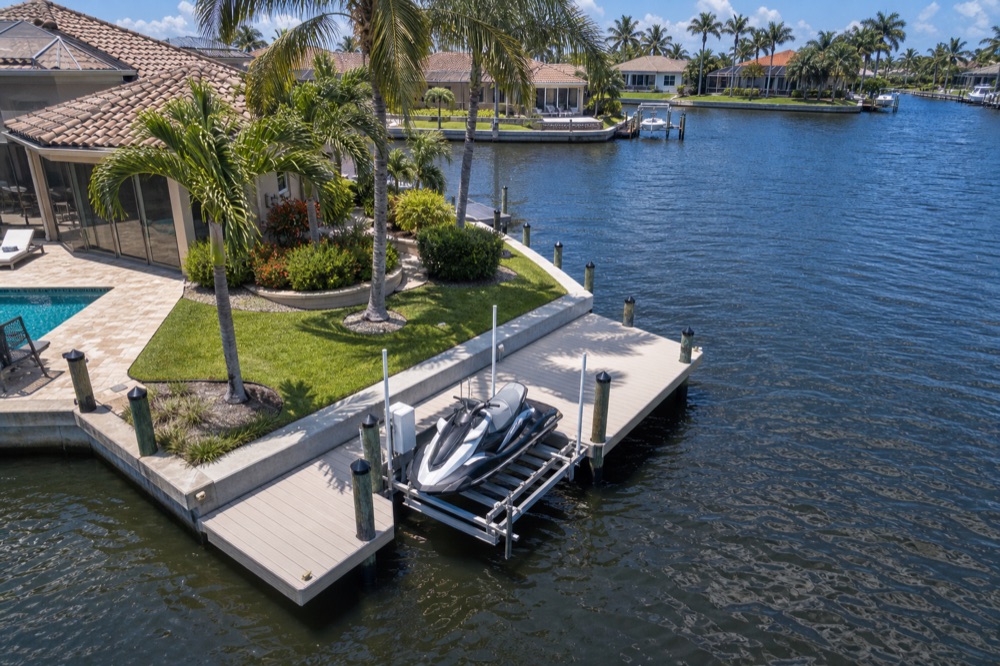
- Ask this first
- Where on the Imperial River your slip sits. Position narrows the boat before capacity comes up.
- The weight that counts
- Loaded and working, never length: hull, engines, batteries, fresh water, a full tank, gear aboard
- Margin
- Another 20 to 30 percent above the loaded number
- Underneath it
- Pilings sized for the load, or a seawall asked to hold a weight that arrives and leaves
- Permitting
- Through the City of Bonita Springs, with state and federal approvals where they apply
Key takeaways
- In Bonita Springs the first sizing question is positional, not mechanical: a slip near the mouth of the Imperial River and a slip well upriver are two different sets of constraints.
- Near the mouth there is more open water in front of the slip and more weather reaching the boat as it lies. Upriver it is narrower and quieter. That shifts how the hull wants to sit and how much work the hardware does, not the rating you buy.
- Size on what the boat weighs loaded and working, not on its length and not on the brochure: hull, engines, batteries, fresh water, a full tank and the gear that never comes back off. At about 6 pounds per gallon, fuel alone moves the total.
- Add 20 to 30 percent above that loaded number. A lift outlasts the boat that justified it, so the margin is really a bet on the next hull.
- The published ranges are on this page in full. Where a Bonita job lands inside them is a site question: the pilings, the access down to the water, and the power run.
Two Bonita Springs docks a few minutes apart can want two different boats. A dredged canal grid does not behave that way, where one address runs out much like the next. A river does.
So the sizing conversation here does not open with a weight. It opens with where on the Imperial River you sit.
Why does river position come before the boat?
Because a river has an upstream and a downstream, and those are not interchangeable addresses.
The Imperial River is the spine of Bonita’s interior water, and the canal neighborhoods hang off the river itself rather than a dredged grid. Sit well upriver and the water in front of you is narrow and sheltered. Sit nearer the mouth, where the river gives out into Fish Trap Bay and then Estero Bay, and open water is close enough that wind reaches the boat where it lies.
One thing stands between those two lives. A fixed highway bridge on US 41 crosses the Imperial River, and it sets a real ceiling on how tall a boat can be to move past that point. Confirm the current clearance yourself before you assume a tower, a hardtop or a mast will pass under it. It gets one sentence here because the Bonita Springs canal and water guide takes the water apart properly, including the run out toward open Gulf water.
Owners who begin at the machine buy capacity their stretch of river was never going to let them use. Begin at the address and nothing downstream has to be undone.
How does position change the lift itself?
Barely at all in the rating. Quite a lot in everything around it.
Treat the two ends of the river as two assignments for one machine. Upriver, the water ahead of a dock has no room to build, the boat stays where you left it, and the week’s real problems are ordinary: getting aboard, getting the cradle under the hull cleanly, and living inside the width you have. That last one bites. A conventional four-post lift needs clearance beside the dock that plenty of these canals off the river do not have, so the project lands on the wall by default rather than preference.
Nearer the mouth the complaint changes shape. There is open water ahead of the dock and the wind makes use of it, so a boat can work against its lines through a windy stretch of days. The arguments worth having there are about bunks, cradle geometry, guide posts, and how well the hardware is shielded from what it stands in.
Neither end is the better address. They are two different assignments, and a company that writes one specification for both has specified neither. Our Southwest Florida boat lifts guide covers what the two have in common underneath, and types of boat lifts explained walks the configurations.
Width is usually what the second craft pays for. A ski in the main slip has to be shifted before the boat goes anywhere, and it never sits properly on cradle hardware rated for something several times heavier. Give it a jet ski lift of its own, wall-mounted where a canal off the river is tight, and both problems close at once.
How do you land on the right capacity?
You assemble that number. You do not look it up.
A brochure weight describes a hull on the day it left the factory: dry, empty, nothing bolted to it. Yours carries engines, batteries, fresh water, a full tank of fuel, and the gear that came aboard one season and never went back off: on this water that means coolers, rods and dock lines that have not seen a garage in years. Fuel alone runs about 6 pounds per gallon, so a bigger tank earns a minute with a calculator rather than a shrug. What size boat lift do I need walks the full calculation.
Then put 20–30% on top of that loaded figure. Boats along this stretch get traded up long before a lift wears out, and the margin you pay for now is what stops the next one forcing a second purchase.
Underneath all of that sits the question owners reach last and quotes reach first: what holds the thing up. Dock-mounted, the answer is the pilings, and the particulars matter, their diameter, how far apart they stand, what they were driven into. Wall-mounted, the answer is a seawall built for one job, holding the soil behind it in place under steady pressure, and now handed a second, taking several thousand pounds on and off its face every time you go out. That is not a disqualification: putting a lift on a seawall with no dock is an ordinary outcome on the narrower canals here. It does not make the structural question go away, though. It hands it to the wall instead of the pilings, and a wall’s answer comes from somebody standing at it.
What does it cost?
Our published ranges, so you can budget before anybody drives out:
- Jet ski lifts: $3,000–$5,000
- 7,000–10,000 lb: $8,000–$13,500
- 16,000 lb: $14,000–$19,000
- 24,000 lb and up, from $22,000
- Canopy: add $14,000–$22,000
On this water, position does a lot of that work: a slip near the mouth usually means a straightforward barge-in, while a stretch well upriver can mean a longer haul for materials and a closer look at what the bank itself will support. Our boat lift cost guide itemizes the components, and covered versus uncovered is worth reading before you decide the canopy is optional or essential.
Every one of those numbers gets finished on your dock, and we will not be argued out of it: a price quoted before anybody has stood on the structure is not an estimate, it is a guess with a decimal point in it.
What is left to settle?
Three things are still open, and picking a model answers none of them.
Permits. Bonita Springs runs its own Community Development Department and publishes its own Dock and Shoreline Permit for work at the shoreline, with state and federal approvals where they apply. Boat lift permits in Bonita Springs covers that ground. We file it in-house.
Install. Once the permit has issued and the materials have landed, the build runs a day or two on-site. Nearly all of a lift project’s calendar sits in front of that: approvals, the order, and driving pilings when the dock does not already carry what the lift needs.
Storms. Where your lift sits when weather is coming is not our call. The manufacturer specifies that position, your insurance policy may attach a condition of its own, and once those two have spoken there is nothing useful left for a contractor to add, ours included.
Bring us three things: where you sit on the river, what the boat weighs loaded, and a straight account of how you use it. The measuring is ours. We will read your pilings and your wall, say which boat lift belongs there, and tell you without dressing it up when the structure under your dock has to be put right first.
Free on-site estimates across Bonita Springs. Call (239) 397-3400.
The rest of our Bonita Springs library: permits, water, storms, and what we actually see on these docks.