
Boat Lift Permits in Port Royal: What Approval Really Involves
Heavier boats change the structural conversation and the electrical one. On Port Royal water, the lift is usually the most engineered thing on the dock.
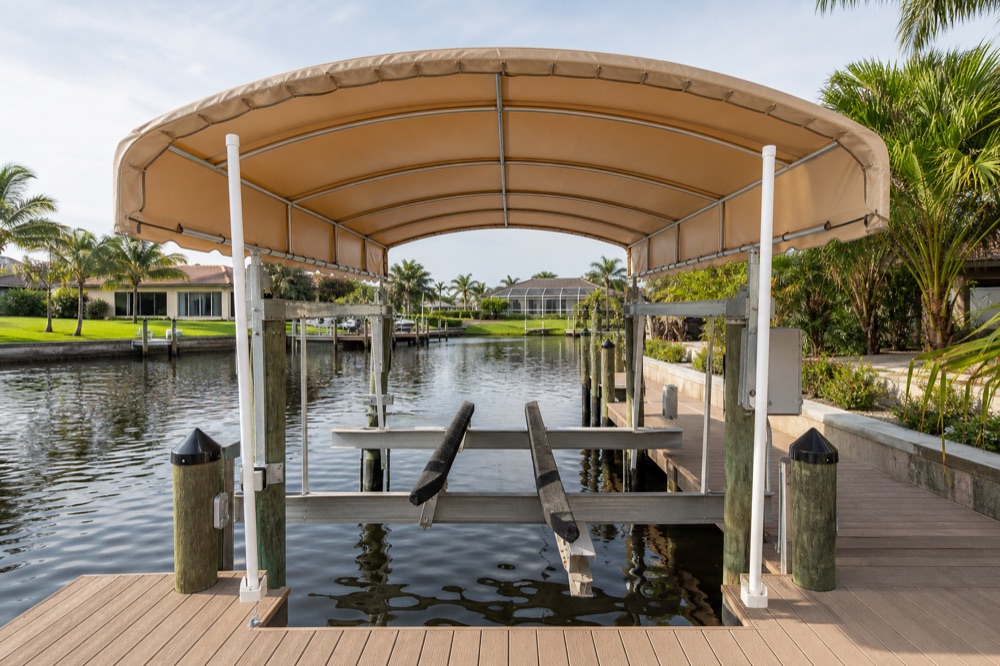
- Jurisdiction
- Inside the City of Naples, the city is your building authority
- The structural driver
- Pilings. Capacity is a piling question before it's a lift question
- The other scope
- Electrical: licensed work, and larger lifts draw more power
- State
- Florida DEP: new pilings go into state-owned submerged land
Key takeaways
- Port Royal sits inside the City of Naples, so the city is the local building authority, the same as anywhere in the city.
- A lift is its own approval. A permitted dock does not cover a lift added to it later.
- At Port Royal capacities, the pilings dominate the structural review, the lift is only as good as what it's mounted to.
- Bigger lifts draw more power, which makes the electrical scope larger, not just longer. It's licensed work.
- Upsizing an existing lift is a structural change, not a swap, no matter how similar it looks from the dock.
The mechanics of lift permitting in Port Royal are the mechanics of lift permitting anywhere in the City of Naples: Port Royal is a neighborhood inside the city, not a separate jurisdiction, and our Naples boat lift permits page covers the process in full.
What changes here is what’s being permitted. On Port Royal water, the lift is usually the most engineered object on the dock, and the review reflects that.
Who reviews it?
The City of Naples Building Department for the local building permit. The Florida Department of Environmental Protection for environmental review and for authorization to use state-owned submerged land, which new lift pilings go into, even when the dock beside them was approved years ago. The U.S. Army Corps of Engineers where navigable waters are involved.
And separately, on its own track: the electrical scope, which is licensed work.
Why doesn’t the dock’s permit cover the lift?
Because the dock’s permit covered the dock. A reviewer looked at a static structure carrying people.
A lift is a different object entirely: a mechanical assembly that raises and holds several thousand pounds, cycles under load repeatedly, and does it in a salt environment. Plus new pilings into state bottom. Plus power over water where there wasn’t any.
That gap is wider at Port Royal capacities than almost anywhere else in the city, which is why treating a lift as a dock accessory doesn’t survive contact with the review.
What does the structural review come down to?
Pilings. More completely here than anywhere else in Naples.
A lift transfers everything into the pilings it’s mounted to, the boat’s weight, the dynamic load of raising it, and wind on the hull when it’s up. Every other component can be specified perfectly and none of it matters if the pilings can’t hold.
Scale that up to the boats Port Royal’s deep, no-bridge canals support, and the piling conversation stops being a detail and becomes the project. How they’re set, what they’re set into, how many, how they’re spaced, and how the whole assembly ties together. How deep lift pilings are driven is worth reading if you want to understand why the piling, not the beam, not the motor: is almost always the binding constraint.
Two situations that come up constantly:
Mounting to existing dock pilings. At smaller capacities this is sometimes fine. At Port Royal capacities it usually isn’t, because pilings set to carry a walkway were not set to carry a large lift. This gets assessed rather than assumed, every time.
Upsizing an existing lift. Owners replace a boat, and the natural next thought is a bigger lift on the pilings that are already there. That is a structural change, not a swap, and it’s the specific shortcut that fails under load. If the pilings were set for the old capacity, they were set for the old capacity.
What’s different about the electrical?
More of it, and the “more” matters.
Larger lifts draw more power. That makes the electrical scope genuinely larger, not just a longer run of the same thing. And the underlying hazard is unchanged and unforgiving: electricity, saltwater, and a large grounded metal structure standing in water that people swim in.
So the rule is the same as everywhere and we’ll state it as directly as we can: electrical is a licensed electrician’s scope. Not an owner’s, not a marine contractor working outside their lane, not a handyman. We coordinate it as part of the project so it’s done by the right trade and inspected properly. Boat lift electrical requirements covers what’s actually involved.
If there’s one paragraph on this page to take seriously, it’s that one.
Does lift type change anything?
It can, and at these capacities the choice is more consequential than it is on a smaller dock.
Hydraulic versus cable lifts covers the trade-offs honestly: different maintenance profiles, different failure modes, different power requirements. Neither is universally right, and the correct answer depends on the boat, the slip, and how the owner actually uses it.
Covers are the other decision. A canopy and a boathouse are different structures with genuinely different permitting weight, a boathouse is a substantial covered structure and it’s a bigger application, covered on our Port Royal dock permits page.
How does capacity actually get set?
By loaded weight, with margin, and it’s worth being precise because getting it wrong at this scale is expensive.
Loaded weight is the boat plus fuel plus water plus batteries plus every piece of gear aboard. Fuel alone runs about 6 pounds per gallon, and on a large tank that’s serious weight before anything else. Then carry 20–30% above that loaded number, not as safety theatre, but because a lift working at its limit every cycle wears cables, motors, and connections harder than one with headroom.
What size boat lift do I need does the arithmetic. Our Port Royal boat lift guide covers how the neighborhood’s water shapes the rest of the specification.
What about executing the work?
Worth flagging, because it’s a real planning input here rather than a footnote.
Port Royal streets are gated and hedged, properties are built out with mature landscaping and finished hardscape, and access for equipment is genuinely tight. A lot of this work stages better from the water than across a finished property, and protection for pavers, irrigation, and plantings gets specified rather than promised. We plan that up front because a contractor who doesn’t will discover it expensively.
What should you confirm?
Your parcel’s jurisdiction, and then current requirements with the authority that has it. Processes and thresholds move, and nothing here substitutes for what the reviewing agency says today about your address.
We permit through the City of Naples in-house and coordinate the licensed electrical scope as part of the job, one crew, one point of contact, and paperwork that holds up when the property eventually sells.
If you’re specifying a lift for Port Royal water, we’ll come look at the pilings, the slip, and the boat and tell you honestly what it takes. (239) 397-3400.
The rest of our Port Royal library: permits, water, storms, and what we actually see on these docks.