
Dock & Lift Repair in Port Royal: Common Failures We See
The same short list of problems, arriving at estate scale, where the load concentrates, what's urgent, and why matching the existing work is half the repair.
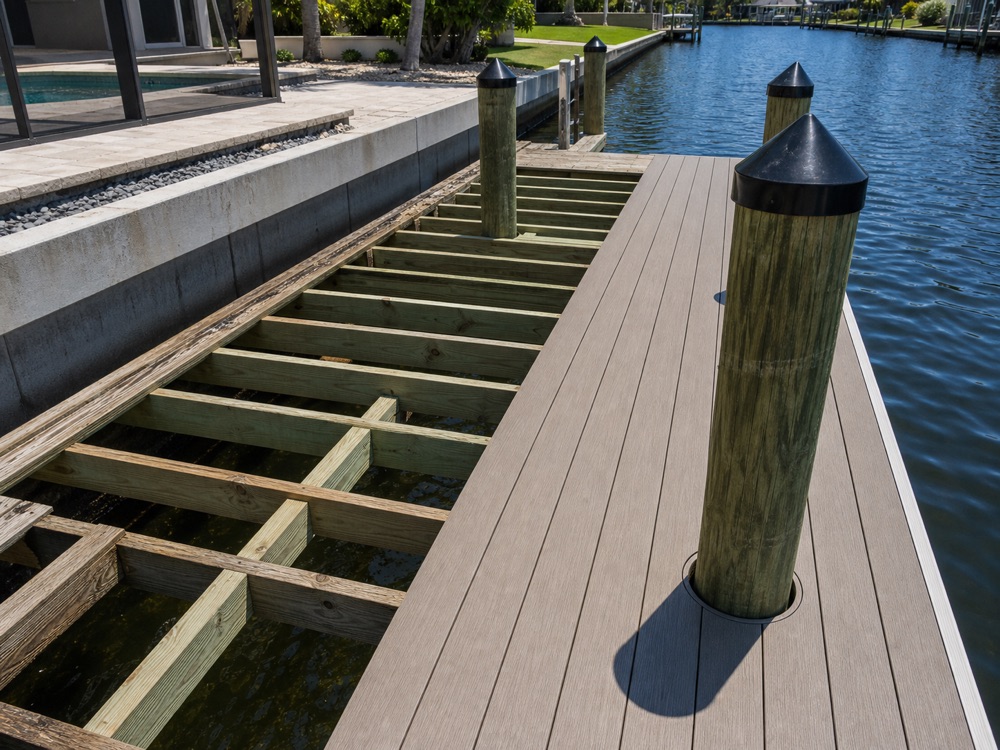
- Where it starts
- Hardware and connections, ahead of the framing they hold
- Stop-work finding
- A piling that gives when you push it
- The local twist
- Bigger structures, bigger loads, fewer places for it to go
- Electrical
- Breaker off, licensed electrician, never trial and error
Key takeaways
- Bigger structures send load through fewer, harder-working connections, which is why hardware fails ahead of the framing it holds together.
- A piling that moves when you push it is the one finding that should stop you loading that part of the dock today.
- Water over the deck applies uplift to every connection and scour to every piling base, and the surface can still look untouched.
- At larger lift capacities a small misalignment stops being cosmetic fast. It turns into cable wear, chewed bunks and off-center piling loads.
- On a Port Royal property the finish is half the repair. Matching weathered material is part of the scope, not an afterthought.
We are on Port Royal water most weeks of the year, and after enough of these docks the failures stop being surprises. It is a short list, and it tends to arrive in roughly the same order.
What is different here is not the list. It is the scale everything happens at, and the standard the repair has to meet, because on a property like this a fix is not finished when it is sound. It is finished when you cannot find it.
Why does scale change what fails first?
Because load has to go somewhere, and on a bigger structure it concentrates at fewer, harder-working points.
Longer spans. Heavier lifts. A larger vessel working against its bunks and lines. All of it runs through the same small parts: bolts, brackets, hangers, and the connections where framing meets piling. Salt then does what salt does to metal already being asked for more.
The result catches owners out. The framing can look sound while the hardware holding it together is quietly finished, so what you notice is not damage. It is a walkway that feels different underfoot than it did last season.
What to look for: rust bleeding down from a fastener, bolts backed out, bolt holes worn from round to oval, gaps opening where two members meet, brackets with visible section loss.
Exposure adds to it. Port Royal’s canals are deep and wide and open to Naples Bay, with a no-bridge run out through Gordon Pass, our Port Royal canal and water guide covers that geography. For a dock, the short version is that the water in front of it has more room to move than a short, protected finger canal does, and moving water works connections.
Which finding should stop you using the dock?
A piling that moves.
Push on it. If it gives, or if a section of dock shifts underfoot when someone walks it, that piling has lost its grip in the soil. That is not a condition it settles into. It gets worse with every tide and every load, and the hole never packs back in.
Stop loading that part of the structure, keep the lift off it, and have someone look before anything else gets planned around it. Repair versus replace on a leaning piling covers what comes next.
Two Port Royal notes. The load standing on these pilings is heavier, so a piling that has started to move carries a bigger consequence. And condition cannot be read from the deck, the part that fails is below the waterline, where borers and section loss work out of sight.
What does water over the deck leave behind?
Uplift on every connection, scour around every piling base, and a deck that can look untouched.
Boards that have been submerged and dried out again move. Timber framing swells and shrinks, snug fasteners stand proud, and composite decking does not rot even when the framing beneath it has taken real damage. The surface is the least informative part of the structure at that point.
So lift a board and look at the framing rather than trusting the top of the deck. Post-storm dock triage covers the full sequence. “It looks fine” describes decking, not structure.
Why is lift alignment its own problem here?
Because a bigger lift punishes a small misalignment.
Cables that are not sharing the load evenly, a cradle sitting out of level, bunks that no longer meet the hull where they were set to: none of it announces itself. It shows up as uneven travel, a slight lean under load, a new sound, chewed bunk carpet, and cables wearing at different rates. Left alone it puts an off-center load into pilings designed for a centered one.
Cables have no honest replacement interval; it depends on use, rinsing and exposure. Inspect the full length, not the run you can see standing on the dock, and act on fraying, broken strands, rust bleeding from inside the lay, or flat spots. Cable replacement warning signs covers what you are looking at. A lift specified with real margin over the vessel’s loaded weight also lives an easier life than one working at its limit every cycle, our Port Royal boat lift guide covers sizing.
If the symptom is electrical, a motor that hesitates, an intermittent control, anything that tingles near the water: kill the power at the breaker and call a licensed electrician. Power over saltwater beside a large metal structure is not a trial-and-error category.
Why does the repair have to disappear?
Because on a Port Royal property the dock is finish work, and a patch that is structurally perfect can still read as damage.
A run of decking that has been in the sun for years will not match a board straight out of the wrapper, and no amount of care changes that at first. The honest options are to accept a visible difference while the new material weathers in, to replace a whole field rather than a single board, or to re-deck the run and be done with it. The same question comes up with piling wraps, caps, cleats and hardware finishes, where profiles and colors have moved on since the dock was built.
Access is the other half. A small repair on a gated, hedged street crosses the same pavers, irrigation and plantings a full build does, so protection gets specified in writing and staging gets planned rather than improvised. Crews work quietly and leave the property as they found it.
What should you check, and how urgent is it?
| What you are seeing | What it points to | What to do |
|---|---|---|
| Rust streaks, loose bolts, oval holes | Connection corrosion | Deal with it early. This is the cheap stage |
| A piling that gives when pushed | Lost grip in the soil | Stop loading it, and get it looked at |
| Cupped, soft or proud boards | Decking, and possibly the framing under it | Lift a board before deciding anything |
| Uneven lift travel, worn cable, chewed bunks | Alignment and wear | Stop cycling it with the boat aboard |
The habits behind that table are small. Push on the pilings once a season. Look along the whole length of the lift cables twice a year. Watch the lawn behind the seawall for soft spots, and treat a rust streak as information rather than as a cosmetic problem.
If something on yours has started moving, sounding different or bleeding rust, we will come and look and tell you plainly what it is, including when the honest answer is bigger than a repair. Dock and lift repair on Port Royal water, free on-site estimate: (239) 397-3400.
The rest of our Port Royal library: permits, water, storms, and what we actually see on these docks.