
Port Royal Canal & Water Guide for Dock Owners
Deep, wide canals off Naples Bay and a no-bridge run out through Gordon Pass. That geography sets the boat, and the boat sets everything your dock and lift have to carry.
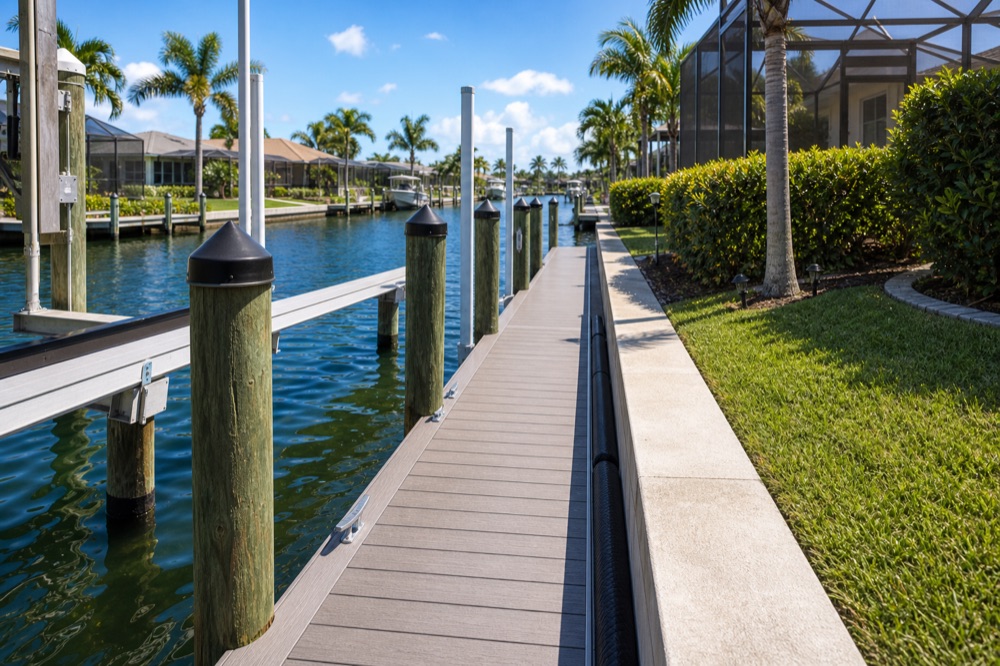
- Where it sits
- South end of the City of Naples: Aqualane Shores north, Naples Bay east, the Gulf west
- The water
- Deep, wide canals off Naples Bay
- Gulf access
- Direct through Gordon Pass, no bridges, a few minutes out
- What that means
- Large vessels, and a dock and lift sized to them rather than to an average
- What we won't publish
- Depths, widths and tide figures. Those get measured at your slip
Key takeaways
- Port Royal's canals are deep and wide, and the run out to the Gulf through Gordon Pass has no bridges in it, a few minutes and you are in open water.
- No bridges means no height ceiling on the way out, which is why the vessels here are large ones, and why the dock, the lift and the pilings all get sized to the boat rather than to an average.
- Tide swing is the constraint owners underestimate. Bunk setting, ladder reach, cleat placement and how you actually board all have a right height for only part of the day.
- Wake from large vessels and chop built by wind crossing open water both put real energy into your slip, all year. All of it ends up in the pilings.
- Depth at your slip at the bottom of the tide is a measurement, not a figure to look up, and we will not publish one for your address.
Every conversation about a Port Royal dock ends up in the same place, so it is worth starting there: the water.
Two facts define it. The canals are deep and wide, and the run out to the Gulf through Gordon Pass has no bridges in it, a few minutes and you are in open water. Almost everything that makes a dock or a lift here different from one at the north end of the city follows from those two facts, and it is worth understanding the chain before anyone quotes you anything.
Where does Port Royal actually sit on the water?
At the south end of the City of Naples, with water on three sides.
Aqualane Shores to the north. Naples Bay to the east. The Gulf to the west. Gordon Pass at the south, the primary deep-water inlet connecting Naples Bay to open water, and Port Royal’s route out.
The rest of the city’s water is useful as contrast rather than comparison. The Gordon River flows into the north end of Naples Bay. On the bay’s east side, Royal Harbor’s shoreline runs from the river down to Haldeman Creek. Further north again, Doctors Pass serves a separate system of bays and is narrower and shallower than Gordon Pass, which is precisely why the two inlets are not interchangeable for anyone deciding where to keep a boat. Our Naples canal and water guide maps the whole system.
What does no-bridge access actually change?
It removes a ceiling, and removing a ceiling changes the boat.
On a bridged canal, height is a hard, permanent constraint. Whatever the lowest span between you and open water allows is the outer limit of what you can keep there, regardless of what the water underneath would happily float. Port Royal has no such limit on the way out through Gordon Pass. Put that together with deep, wide canals and the practical result is that owners here keep large vessels, and the dock and lift have to be built for the actual boat rather than for a neighborhood average.
That chain runs one direction only: the water sets the boat, the boat sets the lift, the lift sets the pilings. Nothing downstream can be specified until the vessel is on the table. Our Port Royal boat lift guide picks up where this page stops.
There is a second, quieter effect. An owner who never has to time a departure around anything uses the boat more, and duty cycle is what actually wears marine hardware out. More cycles on the lift, more hours in the slip, more work for cables, bunks, fenders and cleats.
How does the tide work on your dock every day?
The water moves through a range every day. Your dock does not.
We do not publish tide figures and you should be wary of anyone who does, the swing at your slip is something you observe over a season, not something you look up. The consequence, though, is identical whatever the number: every fixed thing on a fixed dock is at its right height for only part of the day.
That shows up in specific, expensive places:
- Lift bunk and cradle setting. Where the boat gets picked up, and where it sits at rest.
- Ladder reach. A ladder that is comfortable at the top of the tide can be a genuine stretch at the bottom. Reach is the specification owners under-order and then live with for years.
- Cleats and fenders. Lines that are right at one stage are slack or strained at another. Where the cleats sit and how lines are led decides how much daily attention that needs.
- Boarding. How you actually get on and off, at the bottom of the tide, in the dark, carrying something.
- Fixed or floating. A floating dock on guide piles rides the swing rather than arguing with it. It is a real option here, and a different structure, not a cheaper one.
Where does the load on a Port Royal dock come from?
Five places, and only one of them is the boat sitting still.
Static load, the structure plus the vessel at rest. Dynamic load: raising and lowering, which is the hardest thing the assembly does as a matter of routine. Wind on the hull when it is up, a large boat in the air is a sail, and the pilings are what it is attached to. Wake, a wide canal carrying large vessels puts energy into your slip that a short, sheltered spur never sees. Fetch, the run of open water the wind crosses before it reaches you, which is what turns a breeze into chop that works on hardware every windy afternoon. We cover that properly in canal fetch and waves.
All five arrive in the same place: the pilings. That is why capacity here is a piling question before it is a lift question, and why the 20–30% margin over loaded weight is not padding. Loaded weight includes fuel, and fuel is about 6 pounds per gallon: serious weight on a large tank before anyone steps aboard.
The estate-grade part is not decorative either. A Port Royal dock is visible from the house and always visible from the water, so the structure carrying these loads also has to look like it belongs to the property. Both are legitimate requirements and they get designed together rather than traded against each other.
What about depth, dredging, and who maintains the canal?
We will measure the first, we do not do the second, and the third genuinely varies.
Depth. Port Royal is deep water, that is the whole premise. But the number at your slip, at the bottom of the tide, is a measurement someone takes on site. We will not publish a figure, because a figure applied to the wrong address is how a lift gets specified for a condition that does not exist. It is about fifteen minutes on the site visit and it prevents the most expensive category of mistake in this business.
Dredging. Not us. If the honest answer to a slip problem is removing material rather than building something, that is a different trade with its own permitting path. Should I dredge my boat slip or canal covers who does it. We would rather say so than quietly design around it.
Maintenance responsibility. City, county, special district, private. It depends on the waterway and it is not always obvious from looking at it. That distinction matters the moment the question is debris, or something in the water rather than on your land. Who maintains canals in Southwest Florida covers how to find out for your address.
What should you have before anyone designs anything?
Three things, and they are the whole conversation:
- The vessel, loaded, with fuel, water, batteries and gear, because everything else is sized from that number.
- The depth at your slip at the bottom of the tide: measured, not estimated.
- How much open water sits in front of you, and which direction the wind gets at it from.
Bring those and the design conversation gets short and accurate. Or let us come and take them, a free on-site visit anywhere on Port Royal water, from a crew that keeps a private street quiet. (239) 397-3400.
The rest of our Port Royal library: permits, water, storms, and what we actually see on these docks.