
Seawalls & Shorelines in Port Royal: What Holds Up Here
On these canals the wall is part of the landscape, not just infrastructure. That doesn't change the engineering. It changes what 'finished' means, and how a problem gets noticed.
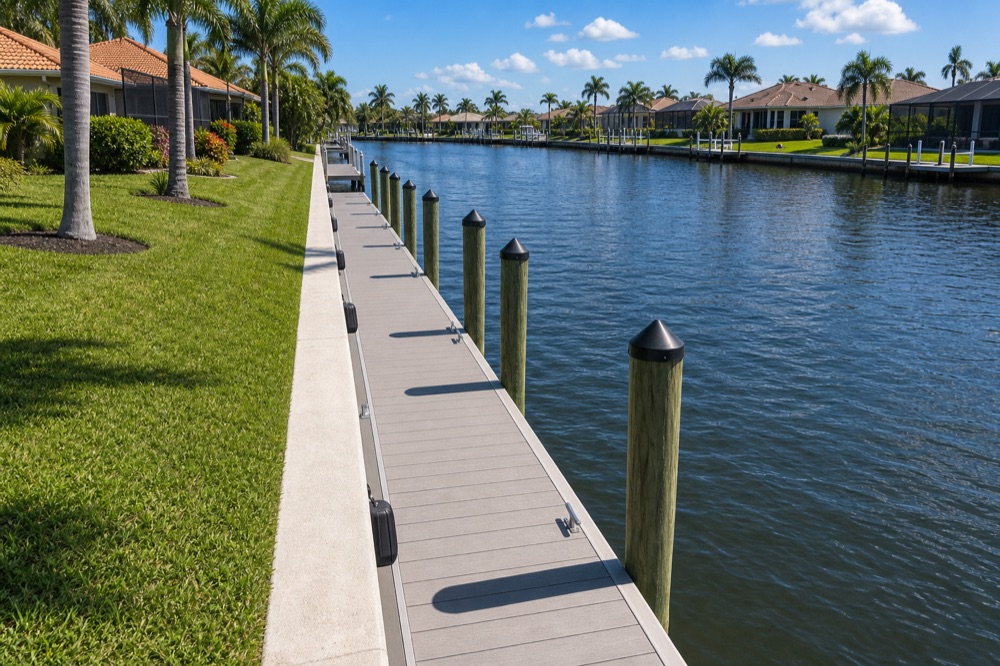
- What you'll see
- Concrete and vinyl walls, with rock increasingly used at the toe
- What fails first
- Tiebacks, drainage and the toe: rarely the wall face itself
- The local twist
- The wall is finish as well as structure, and it's read from the water
- The detection problem
- A maintained lawn hides the early warning signs
- Permitting
- City of Naples: seawall plans sealed by a registered engineer or architect
Key takeaways
- In Port Royal the seawall is part of the finished landscape, so it carries a finish standard on top of a structural one. They are two different jobs and only one of them keeps the wall standing.
- Walls on this coast almost never fail at the face. Corroded tiebacks, blocked drainage and a scoured toe are what actually end them.
- A maintained estate lawn hides the early warning. Dips get filled and pavers get reset long before anyone reads them as a symptom.
- Look at your wall from the water occasionally. A lean or a bow shows from a boat well before it shows from the lawn.
- Rock at the toe is the most direct answer to scour there is, and on a designed shoreline, how it is placed belongs in the scope.
In most of Southwest Florida a seawall is infrastructure. It holds the yard up, nobody looks at it, and it gets attention the week it starts failing.
Port Royal is the exception. Here the wall is part of the finished landscape, the edge of the lawn, the view from the terrace, the line the whole property reads against from the water. None of that changes the engineering. It changes what “finished” means, and how a problem gets noticed.
What is the water in front of your wall doing to it?
Working on it, all year, mostly at the bottom.
A wall has two adversaries: the saturated ground behind it and the moving water at its base. Port Royal’s canals are deep and wide with a direct, no-bridge run out through Gordon Pass, that geography is the neighborhood’s whole premise and it gets its own guide in this set. For seawall purposes the consequence is short. There is more open water in front of you than a short, sheltered spur has, wind gets a run at it before it reaches your shoreline, and the vessels moving on it are large ones.
None of that needs a number to matter. It adds up to a toe being worked on continuously, not just in storm season.
Which walls are actually out here?
Concrete and vinyl, and on an estate shoreline the cap does double duty.
Concrete is what you will find along most of the older waterfront. Substantial, heavy and long-lived, provided the reinforcement inside it stays protected. Its enemy is simple: water reaching steel, usually through cap cracks and open joints. That is why cap condition is not a cosmetic subject even when it looks like one.
Vinyl turns up more on newer construction and on replacements. Lighter, it does not corrode, and the panels are immune to the chemistry that attacks concrete. Its lifespan still rides on the parts that are not vinyl, the tiebacks, the cap and the anchoring system behind the wall.
Our seawall page covers both. The point worth internalizing before you form a preference: what a wall is made of matters far less to its lifespan than what sits behind it and beneath it.
Which parts are structure, and which parts are finish?
Both at once, and confusing them is the expensive mistake.
| Part of the wall | The structural question | The finish question |
|---|---|---|
| Cap | Is water reaching steel through cracks or open joints? | Is the top surface true and clean where it meets pavers and turf? |
| Face and panels | Is a section leaning, bowing or out of line with its neighbors? | Does the wall read as one continuous line from the water? |
| Toe | Is sand moving out from under the base? | Where rock is used, does it look placed rather than dumped? |
| Tiebacks | Are the buried anchors still holding? | Nothing visible, which is exactly the difficulty |
| Ground behind | Soft spots, dips, settling pavers | Irrigation, lighting and plantings sit directly on top |
Read down the middle column and you have the condition of the wall. Read down the right and you have what the owner sees. On a Port Royal property those columns diverge further than anywhere else on this water, because the right-hand one is maintained to a standard that quietly covers the left.
Why is a problem harder to spot on a property like this?
Because everything that normally gives the warning is being tidied up.
Elsewhere the first symptom of a failing wall is not the wall. It is a soft patch of lawn, a dip along the wall line, a settled paver: soil escaping through or under the structure long before anything looks wrong. That is still true here. What is different is that a Port Royal lawn is irrigated, replanted and groomed on a schedule. The dip gets filled. The paver gets reset. A soft spot in a planting bed reads as an irrigation problem, because most of the time it is one.
Nobody is at fault. The property is simply being corrected faster than the symptom can accumulate. Two practical answers:
- Tell whoever maintains the grounds what to report to you. Settlement along the wall line, a paver needing a second reset, a bed that stays soft after the irrigation has been checked.
- Look at the wall from the water. A lean, a bow, or a section out of line with its neighbors is obvious from a boat and nearly invisible from the lawn. Signs your seawall is failing has the full list.
Where does rock fit on a designed shoreline?
Mostly at the toe, and here it also has to look like it belongs.
Rock at the base of a wall absorbs wave energy before it reaches the structure and stops moving water carrying sand out from underneath. That addresses scour directly, and scour is the failure this water drives hardest. Rip-rap to protect a failing seawall toe covers when it is the right call.
The Port Royal considerations are real ones. Rock needs horizontal room to slope properly. Stone selection, how far the run goes, and how it meets the steps, the dock and the lift are design decisions on a shoreline that was designed. And it has to leave you your access: reaching a boat, a ladder and a lift past a rock toe is planned for, not discovered. Our rip-rap page covers the treatment properly.
Where there is room for it, rock is also better habitat than a vertical wall.
What does a wall project actually look like on an estate lot?
Planned before it is built, and specified in writing.
Two things drive that. First, the design requirement: seawall plans here must be sealed by a Florida-registered professional engineer or architect, which puts a design phase in front of the permitting phase. Our Port Royal seawall permits page covers who signs off and in what order.
Second, access. Gated, hedged streets. Properties built out to their edges. Pavers, irrigation lines, landscape lighting and mature plantings sitting exactly where the work has to happen. Much of this work stages better from the water than across a finished property, and protection and restoration belong in the scope as written line items rather than a verbal promise about being careful.
If a lift is also in your plans, and a wall project and a Port Royal boat lift often arrive together: sequence them deliberately. It is far less disruptive to open the shoreline once.
Every seawall on this coast is on a clock. Port Royal does not change that; it changes how well the clock is hidden. If the ground along the wall has been made good more than once, if a paver keeps settling, if a section looks out of line when you come in from the water, that is the moment a look is worth the most.
Free on-site estimate on Port Royal water. Call (239) 397-3400 and we will assess the cap, the face, the toe and the ground behind it.
The rest of our Port Royal library: permits, water, storms, and what we actually see on these docks.