
Boat Lifts in Port Royal: Canals, Depths & the Right Setup
Deep water, wide canals, and no bridges between you and the Gulf. That geography sets the boat, and the boat sets everything else about the lift.
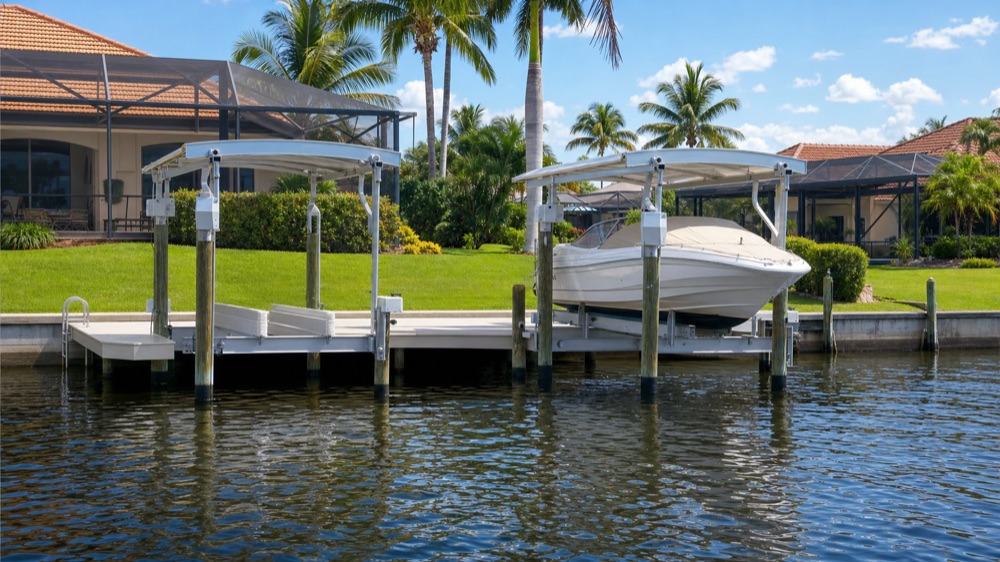
- The water
- Deep, wide canals with no-bridge Gulf access via Gordon Pass
- What that means
- Larger vessels than a typical Naples finger canal supports
- The binding constraint
- Pilings: capacity is a piling question first
- Capacity margin
- 20–30% over loaded weight, and it matters more at scale
Key takeaways
- Port Royal's deep, wide, no-bridge canals are why the boats here are larger, and the boat drives every other decision.
- At these capacities the pilings are the project. The lift is only ever as strong as what it's mounted to.
- Slip geometry matters more than it does on a narrow canal: approach, turning room, and how the vessel sits at rest.
- The 20–30% capacity margin over loaded weight is not optional at scale: duty cycle is what wears a lift out.
- Covered versus open is a bigger decision here, because the structure is bigger and so is the wind load.
The lift conversation in Port Royal starts with the water, and the water here is unusual enough to change every answer that follows.
Deep, wide canals with direct, no-bridge access to the Gulf through Gordon Pass, a few minutes out. The neighborhood sits at the southern end of the City of Naples, with Aqualane Shores to the north, Naples Bay to the east, the Gulf to the west, and the pass at the south.
That geography is why the boats here are larger than what a typical Naples finger canal supports. And the boat, not the address, sets everything else.
What actually drives the specification?
Four things, in order of how much they constrain the design.
The vessel. Loaded weight: boat, fuel, water, batteries, gear, with 20–30% margin above it. Fuel alone runs about 6 pounds per gallon, which on a large tank is serious weight before anything else goes aboard. That margin isn’t safety theatre: a lift working at its limit on every cycle wears its cables, motors, and connections harder than one with headroom, and at these capacities that wear is expensive. What size boat lift do I need does the arithmetic properly.
The pilings. Everything transfers into them: static weight, the dynamic load of raising, and wind on the hull when it’s up. This is the binding constraint at Port Royal scale, and it’s covered on our Port Royal boat lift permits page because it’s also where the structural review concentrates.
Slip geometry. Underrated, and it matters more here than on a narrow canal. How the vessel approaches, whether there’s turning room, how it sits at rest relative to the dock and the seawall, and how someone actually boards it. A lift that’s correctly sized and awkwardly placed is a lift the owner resents.
Depth at the slip at the bottom of the tide. Port Royal’s depth is a genuine advantage: it’s the neighborhood’s whole premise, but the number at your slip at low water is still a measurement someone takes, not a figure to look up.
Doesn’t the deep water make this easy?
Easier than a shallow canal, genuinely. A lot of the configuration gymnastics that shallow Naples slips require; low-tide setups, specialized cradle arrangements, simply don’t apply when there’s water under the boat at every stage of the tide.
What replaces that problem is scale. A larger vessel means more of everything: more capacity, more piling, more structure, more electrical, more wind load when it’s up. The engineering gets more serious rather than less.
The no-bridge access matters too, and not just for convenience. It means the vessels here aren’t height-constrained on their way out, which widens what owners actually keep, and widens what a lift has to accommodate.
What lift types come up?
At these capacities the choice is more consequential than on a smaller dock.
Hydraulic versus cable is the real decision. They have different maintenance profiles, different failure modes, and different power requirements, and both are legitimately used at larger capacities. Neither is universally right. It depends on the vessel, how often it’s used, and how the owner wants to maintain it.
Types of boat lifts explained covers the broader categories, and it’s worth reading before you have an opinion about what you want.
Secondary lifts are common here too. Jet skis, tenders, and small craft usually get their own dedicated solution rather than sharing the main slip, and jet ski lifts run $3,000–$5,000 from our configurator.
Covered or open?
A bigger decision here than elsewhere, because the structures are bigger.
A canopy is a fabric cover on the lift frame. It keeps sun and rain off, which meaningfully preserves upholstery, canvas, electronics, and finishes: genuinely valuable if the vessel sits between uses, which for a lot of seasonal owners it does. From our configurator, add $14,000–$22,000.
A boathouse is a permanent covered structure, a substantially bigger permitting conversation, and a different piece of architecture on the property. It’s a real option on Port Royal water. Boathouse versus lift canopy covers the choice, and our Port Royal dock permits page covers the approval side.
The consideration on both: a larger covered structure catches more wind, on the same pilings, in storm season. That’s not an argument against it: it’s an argument for building it properly and for knowing your lift’s storm position, which comes from the manufacturer and from your insurance policy rather than from general advice.
What does it cost?
Straight from our configurator:
- Jet ski lifts: $3,000–$5,000
- 7,000–10,000 lb: $8,000–$13,500
- 16,000 lb: $14,000–$19,000
- 24,000 lb and up, from $22,000
- Canopy: add $14,000–$22,000
What moves a Port Royal project within or above those ranges is capacity, pilings, electrical, and access. Boat lift cost in Southwest Florida breaks the components down.
We quote on site rather than over the phone, and at this scale that’s not a sales tactic, a number given before anyone has looked at the pilings, the slip depth, and the access route is a number that will change.
What about materials and upkeep?
Salt does not care what neighborhood it’s in.
Aluminum versus galvanized in saltwater covers the real trade-offs. At larger capacities the hardware is working harder, which makes the material and finish decisions worth more attention rather than less.
The maintenance that actually determines lifespan is unglamorous and mostly free: rinse with fresh water, keep zinc anodes current, and inspect cables along their full length rather than the visible run. Boat lift maintenance in saltwater covers the routine, and it’s the single highest-return habit an owner can build.
The part that isn’t about the lift
Executing the work on a Port Royal property is its own planning problem, and we raise it early because it shapes both the schedule and the number.
Gated, hedged streets. Properties built out to their edges with mature landscaping, pavers, and finished hardscape. Equipment access that has to be routed in advance rather than improvised. A great deal of this work stages better from the water than across a finished property, and protection for what’s already there gets specified in writing, not promised verbally.
We plan that as part of the scope. A contractor who hasn’t thought about it discovers it in week two, on your property.
The summary
Bring us the vessel’s loaded weight, what you want the slip to do, and how you’d like to board it. We’ll measure the depth, assess the pilings, work out the access, and tell you what it actually takes, including when the honest answer is that the existing pilings won’t carry what you’re asking for.
Free on-site estimate on Port Royal water: (239) 397-3400.
The rest of our Port Royal library: permits, water, storms, and what we actually see on these docks.