
Dock Permits & Approvals in Port Royal: The Homeowner's Map
Port Royal sits inside the City of Naples, so the agencies are familiar. What's different is the scale of what gets reviewed, and how the work has to be executed once it's approved.
- Jurisdiction
- Port Royal is inside the City of Naples, the city is your building authority
- State
- Florida DEP: environmental review plus use of state-owned submerged land
- Federal
- U.S. Army Corps of Engineers, for work in navigable waters
- What's different here
- Larger structures, larger vessels, and genuinely tight site access
Key takeaways
- Port Royal addresses sit inside the City of Naples, so the City of Naples Building Department is your local authority: confirm your parcel's jurisdiction before you file.
- The agencies are the same as anywhere in the city. The scale of what they're reviewing is not.
- Deep, wide canals with no-bridge Gulf access mean larger vessels, which means larger structures and more review.
- How much of the waterway a dock occupies is a real constraint, and it binds harder on a big slip than a small one.
- Access and staging on gated, hedged streets is a genuine planning problem here, not an afterthought.
Port Royal permitting starts with a fact worth stating plainly, because owners new to the neighborhood sometimes assume otherwise: Port Royal is inside the City of Naples. It’s a neighborhood at the southern end of the city, west of U.S. 41: bounded by Aqualane Shores to the north, Naples Bay to the east, the Gulf to the west, and Gordon Pass to the south. It has no government of its own.
So the agencies are exactly the ones on our Naples dock permits page, and that page covers the mechanics properly. What’s worth its own treatment is everything that’s genuinely different about doing this work here.
Who reviews it?
The City of Naples Building Department for the local building permit. The Florida Department of Environmental Protection for the environmental resource review and for authorization to use state-owned submerged land, which your dock stands on, because you own to the water, not the bottom. The U.S. Army Corps of Engineers where navigable waters are involved.
The order holds: the state side clears before the local building permit issues. It’s a chain, not a set of parallel errands.
★ Confirm your specific parcel’s jurisdiction before you file. It’s a five-minute check and it determines the whole path.
What’s actually different about Port Royal?
Scale. Almost entirely scale, and it cascades.
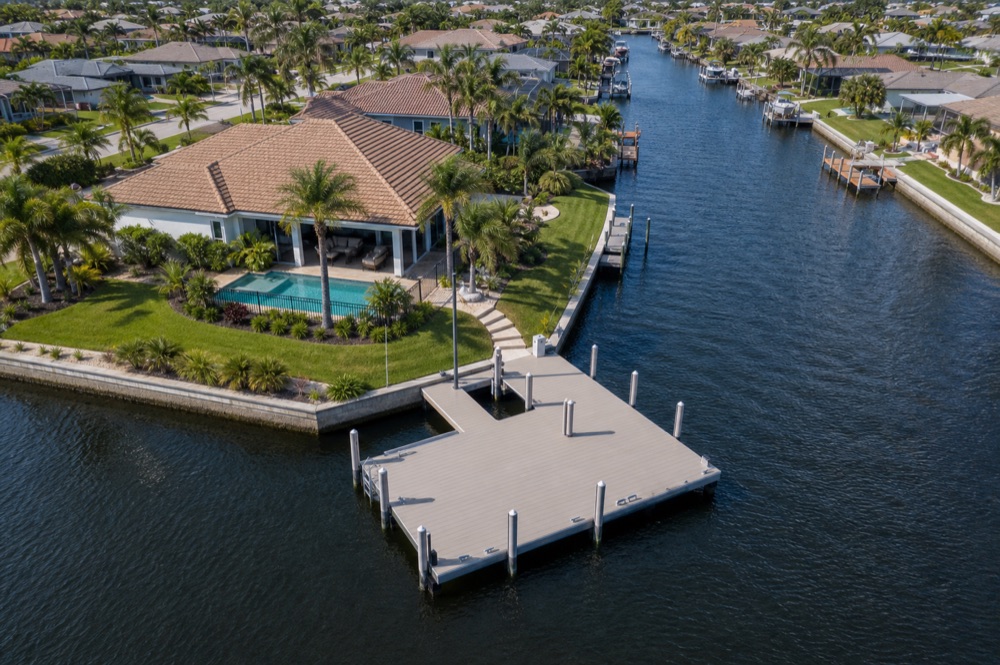
Port Royal’s canals are deep and wide, with direct, no-bridge access to the Gulf through Gordon Pass, a few minutes out. That geography is the neighborhood’s entire reason for existing in its current form, and it means the boats here are substantially larger than what a typical Naples finger canal supports.
Larger vessels drive everything downstream:
- Bigger slips, which means more of the waterway occupied.
- More pilings, set to carry larger loads and longer spans. How many pilings for a given dock size covers the logic; the answers land differently at this scale.
- Heavier lift capacity, with its own structural and electrical implications: covered on our Port Royal boat lift permits page.
- More review, because a larger structure is a larger thing to evaluate.
None of that makes approval unlikely. It makes early design conversations more valuable, because redrawing a large dock late is expensive in a way redrawing a small one isn’t.
Where does the design actually get constrained?
Three places, and only one of them is about what you want.
How far into the waterway you can go. Every jurisdiction limits how much of the water a residential dock occupies. We’re not printing a number. Those move, and a stale figure from a contractor’s website is how a design gets built around a rule that isn’t the rule. What matters is that this constraint binds harder when you’re accommodating a large vessel, so it’s the first thing to establish rather than the last. How much of the canal your dock can take up covers the concept.
What’s on the bottom. Seagrass presence and extent genuinely shape what can be built and where, and establishing it may involve a survey. Seagrass surveys and dock permits covers the process. This is a bottom question, not a property question, and it doesn’t care about the house.
Depth and the shape of your shoreline. Port Royal’s depth is a genuine advantage here: it’s why the neighborhood works for large boats, but the specific depth at your slip at the bottom of the tide is still a measurement someone takes, not a number anyone should quote you.
What about a boathouse?
A real option on Port Royal water, and a meaningfully different application than an open dock.
A covered structure adds height, roof area, and wind load, and it reads differently in review than a flat dock does. It’s a bigger conversation than a lift canopy and it deserves to be started early. Boathouse permits in Florida covers what’s involved, and boathouse versus lift canopy covers the choice.
The part that isn’t on any permit: getting the work done
This is where Port Royal projects genuinely differ from the rest of Naples, and it’s worth planning for.
The streets are gated and screened by hedges, and the properties are built out to their edges with mature landscaping, pavers, and finish work that costs real money to repair. That creates practical problems that have nothing to do with regulatory approval and everything to do with executing the job:
- Access for equipment and materials is genuinely tight. Route and staging get planned in advance, not improvised on day one.
- Water-side access matters more here. A lot of this work is better staged from a barge than dragged across a finished property, and that’s a scheduling and cost input rather than a preference.
- Protecting what’s already there. Pavers, irrigation, landscape lighting, and plantings are all in the way, and “we’ll be careful” is not a plan. Protection gets specified.
- Discretion. Crews on a Port Royal property are on a private street in a neighborhood that values privacy. That’s a real expectation and we treat it as one.
We raise this in the first conversation because it shapes the schedule and the number, and because a contractor who hasn’t thought about it will discover it expensively in week two.
What about replacing an existing dock?
Generally a different conversation than a new build, but only generally.
Like-for-like replacement is treated differently from a new structure. A replacement that’s longer, wider, adds a lift, adds a cover, or changes the footprint moves back toward a new-build review. On Port Royal properties, “while we’re at it” is a common and reasonable instinct, and it’s exactly the instinct that turns a replacement into a new application. Worth knowing before you scope it. Permits to replace an existing dock, lift, or seawall covers where the line falls.
And the question underneath it: was the existing structure permitted? Plenty of older docks on this coast weren’t. On an estate property, discovering that during a sale is a particularly bad moment, the transaction is large and the timeline is short. Unpermitted dock and seawall work when buying or selling covers how that plays out.
What should you do first?
Confirm your parcel’s jurisdiction. Establish the waterway constraint and what’s on the bottom before you fall in love with a layout. And confirm current requirements with the authority that has jurisdiction, or let us do it, which is what we do as part of the job.
We permit through the City of Naples in-house, and we plan access and protection as part of the scope rather than as a surprise.
If you’re planning a dock on Port Royal water, the useful first step is having someone look at the shoreline, the depth, and the access. Free on-site estimate: (239) 397-3400.
The rest of our Port Royal library: permits, water, storms, and what we actually see on these docks.