
Living on a Naples Canal: The Owner's Orientation
The things nobody tells you at closing, about tides, neighbors, wildlife, salt, and the small habits that make waterfront ownership easy instead of constant.
- The daily reality
- Salt is always working. Rinse habits do more than any product
- The seasonal one
- Tides swing more at some times of year than others
- Wildlife
- Check FWC for anything with a season, a limit, or a rule
- The neighbor thing
- Wake, light, and noise carry across water far better than across lawns
Key takeaways
- Salt never stops working. A freshwater rinse habit does more for your dock and lift than anything you can buy.
- Tide swing is a bigger daily factor than new owners expect, and it shapes ladders, lines, and lift settings.
- Wildlife rules change. For anything with a season, a size, or a limit, check with FWC rather than a neighbor.
- Sound, light, and wake carry across water in ways they never do across lawns. Good canal neighbors know this.
- The small accessories: ladder, cleats, lighting, a rinse hose: are what turn a dock from a structure into something you use.
Buying on a Naples canal comes with an orientation nobody gives you. The realtor covers the house. The inspector covers the house. And then you move in and discover that living on the water has its own set of rhythms, habits, and etiquette that everyone around you already knows.
Here’s the version we’d give a new neighbor.
The thing that never stops: salt
Salt is not an event. It’s a condition, and it’s working on everything metal on your property every hour of every day.
New owners tend to respond to this by buying things: coatings, treatments, sprays. The owners who actually do well respond by building a habit: rinse with fresh water. The lift after use. The hardware periodically. Anything metal, regularly.
That single habit does more for the lifespan of a dock and lift than any product on a shelf. Boat lift maintenance in saltwater covers what else belongs in the routine, and zinc anodes are the cheapest, most-neglected part of it: sacrificial pieces that corrode so your expensive components don’t.
Growth is the visible cousin of the same problem. Barnacles on pilings are normal and mostly cosmetic: right up until they’re hiding the condition of the piling underneath. Keeping the boat on a lift rather than in the water is the single largest reduction in growth issues available to you.
The thing that surprises people: tide
Not the existence of tide, the swing. How much the water moves at your dock, day to day and season to season, shapes more of daily life than new owners expect.
It affects how you board the boat, whether your ladder is long enough at the bottom of the tide, how you set dock lines, and where your lift needs to sit to be usable rather than just functional. It also affects what the water looks like at your slip at the worst moment, which is the number that matters for lift configuration.
Practical version: know what your slip does at low water. Then set your ladder, your lines, and your lift for that condition rather than for the pleasant afternoon when you happened to look.
The wildlife conversation
You’ll see a lot of it. Fish under the lights, birds on every piling, rays and snook in the shallows, and, if you’re lucky: manatees moving through.
★ The rules change, and you should get them from the source. Seasons, size limits, protected species, and what’s permitted around them are all set by the Florida Fish and Wildlife Conservation Commission, they’re updated, and they’re enforced. For anything with a season, a limit, or a protected status, check with FWC rather than going on what a neighbor told you at a dock party. Secondhand wildlife information is how people get fined.
Two practical items:
Birds are the universal complaint, and there’s no single fix. What works is removing comfortable perches, being consistent instead of sporadic, and rinsing before buildup sets. Keeping birds off a dock and lift covers what actually helps.
Mangroves are protected, and trimming them is regulated with real penalties. We don’t trim mangroves. If yours are blocking a view, mangroves blocking your view and Florida mangrove trimming rules cover what your actual options are.
The neighbor part
Water carries things that lawns don’t. This catches people.
Sound travels across a canal remarkably well. A conversation on your dock at 10pm is a conversation in someone’s bedroom across the water.
Light does the same. Dock lighting is genuinely useful, for safety, for using the space at night, for finding the boat, but a badly aimed floodlight lights your neighbor’s living room. Good dock lighting is about placement and warmth, not brightness, and it’s one of the more satisfying upgrades to get right. Underwater fish lights are the other half of that, and they’re a genuine pleasure at night.
Wake is the one with structural consequences. Your wake works someone else’s dock, their lines, and their seawall toe. Idle speed in a residential canal isn’t just courtesy: it’s the difference between being a good neighbor and being the reason a wall scours.
Who owns the water?
Not you, generally, and who’s responsible for maintaining it varies.
City, county, special district, or private, depending on the waterway. That matters when the question is dredging, debris, or a problem in the water rather than on your land. Who maintains canals in Southwest Florida covers how to find out for your address.
Two things worth knowing about us specifically: we don’t dredge, and we don’t trim mangroves. If your slip has shoaled in or your shoreline vegetation is the issue, those are different trades and different permitting paths; should I dredge my boat slip covers the first one. We’d rather point you correctly than take a job we’re not the right people for.
What actually makes a dock usable?
The small stuff, mostly. This is the part owners underinvest in and then wish they hadn’t.
- A ladder that works at low tide, not just at high. The single most common regret.
- Enough cleats, in the right places. Cheap, and the difference between tying up easily and wrestling.
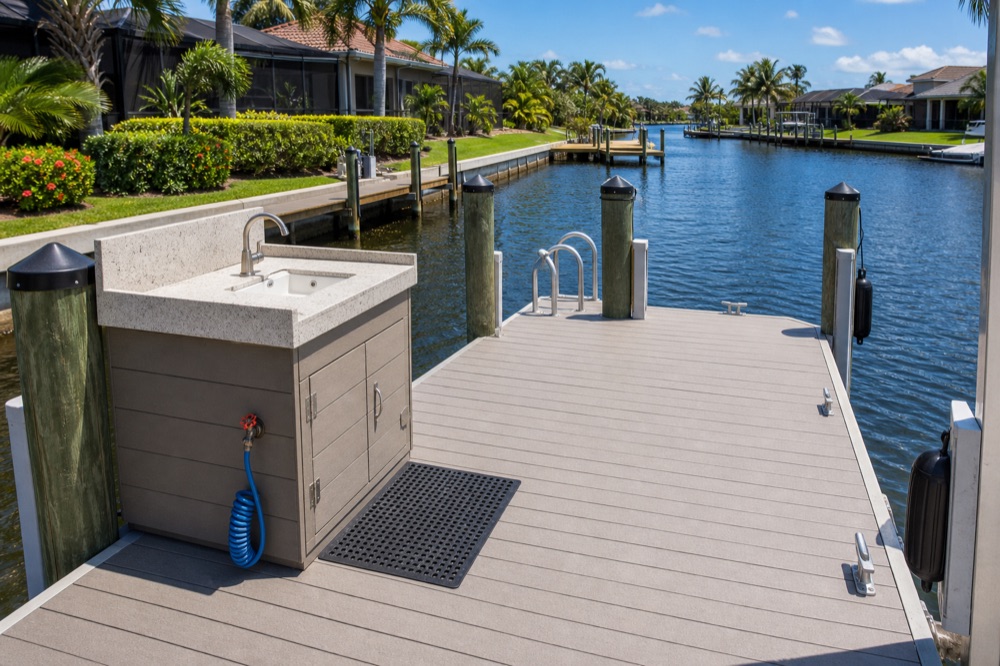
- A freshwater hose at the dock. Enables the rinse habit that everything above depends on.
- A fish-cleaning station if you fish, which most people here end up doing.
- Lighting you can actually see the deck by, aimed down rather than out.
- Storage for lines, fenders, and gear, which also means it’s off the deck when a storm comes.
Essential dock accessories and upgrades covers the full list. And if kayaks or paddleboards are in your future, and on the protected Naples water and up the Gordon River, they should be; storage racks and small-craft lifts solve that neatly.
If you’re not here year-round
A lot of Naples is seasonal, and an empty house on the water is a different maintenance problem than an occupied one.
The two that matter: someone needs to be able to physically reach your dock on short notice during storm season, and the salt keeps working whether you’re watching or not. Dock and lift care while you’re away covers the routine, and remote storm prep for seasonal owners covers the part that has a deadline.
The season
It’s worth saying plainly, once: storm season is part of this. It’s manageable, it’s mostly logistics, and the work that matters happens in spring rather than during a watch. Hurricane prep for Naples waterfront covers the rhythm, and if it’s your first year, the calm guide to a first storm season was written for you specifically.
The short version
Rinse things. Know what your slip does at low tide. Get wildlife rules from FWC, not from the canal. Keep your light and your wake to yourself. And spend a little on the small dock hardware, because that’s what turns a structure into a place you actually use.
Welcome to the water. If you need anything built, fixed, or looked at: (239) 397-3400.
The rest of our Naples library: permits, water, storms, and what we actually see on these docks.