
Dock & Lift Repair in Naples: Common Failures We See
The same handful of problems, over and over, across Naples canals: what causes them, which ones are urgent, and which ones people wait too long on.
- Most common
- Connection corrosion: fasteners and brackets before anything else
- Most urgent
- A piling that moves when pushed
- Most ignored
- Lift cables, until they fail
- Most expensive to delay
- Anything on the seawall
Key takeaways
- Salt gets the connections first. Fasteners and brackets fail long before the timber they hold together does.
- A piling that moves when you push it is the one finding on this list that should change your plans today.
- Lift cables are the most-ignored wear item on the water, and they fail in a way that damages the boat.
- Exposure drives the pattern, a dock on open water and a dock on a protected finger canal wear out differently.
- New decking over old framing is the most common cosmetic fix on this coast, and it hides the thing that actually matters.
We work on a lot of Naples docks, and after enough of them the patterns get repetitive. It’s largely the same handful of failures, in roughly the same order, across canals all over the city.
That’s useful, because it means you can check for them yourself.
What goes first?
The connections. Almost always.
Salt air and salt water attack hardware faster than they attack structural timber. Fasteners corrode, bolts lose their grip in the wood, brackets thin, and joints that were tight start to work. The framing looks fine. The dock feels different.
That “slightly bouncy” or “a bit loose” sensation owners describe is usually hardware, not lumber. And it’s the cheapest problem on this page to fix early, while being one of the more expensive to ignore, because once members start working against each other they wear each other out and the hardware failure becomes a framing failure.
What to look for: rust staining running down from a fastener, bolts that have backed out, bolt holes that have elongated into ovals, gaps opening where two members meet, brackets with visible section loss.
What’s most urgent?
A piling that moves.
If you push a piling and it gives, or a section of dock shifts underfoot when someone walks it, that piling has lost its grip in the soil. That’s not a stable condition it will settle into: it’s an active one that gets worse with every tide, every wake, and every load you put on the dock.
Movement never reverses. The sand doesn’t pack back in. The hole only gets bigger.
That’s the one finding on this page that should change your plans today rather than this month. Repair versus replace on a leaning piling covers what happens next, and piling inspection after a storm covers how to read one properly.
What’s most ignored?
Lift cables, without much competition.
They’re the wear item people look at least and depend on most, and they fail in the worst possible way: suddenly, under load, with a boat in the air. The damage is rarely limited to the cable.
There’s no honest replacement interval. It varies with use, rinse habits, and exposure. What there is, is inspection. Look along the full length of the cable, not just the visible run from the dock. The warning signs are fraying, broken strands, rust bleeding out from inside the lay of the cable, and flat spots where it’s been crushed or run over a bad sheave. Any of those means replace, now, not next season. Cable replacement warning signs covers it in detail.
While you’re there: zinc anodes are the cheapest maintenance on a lift and the most commonly neglected. They’re sacrificial by design, and once they’re gone, whatever they were protecting is next in line.
What’s most expensive to delay?
Anything on the seawall.
Docks and lifts degrade in ways that stay roughly proportional, a bad board is a bad board, a worn cable is a worn cable. Seawalls don’t work like that. A compromised joint or a clogged weep hole is actively removing soil from your yard, invisibly, and the cost curve is not linear.
The Naples seawall guide covers the failure modes; the cost of delaying seawall repair is blunt about the math. Add the fact that Naples seawall work requires engineered plans, a design phase before a build phase, and “next year” becomes a genuinely expensive decision.
Does location in Naples change the pattern?
It changes the pace and the emphasis.
Exposed docks, on open water, on the broader bays, on long runs with real fetch: see more mechanical work. Chop moves things. Fenders wear, hardware loosens faster, boats work against their bunks, and everything cycles more.
Protected finger canals see less movement and more of the slow chemistry: corrosion, growth, borers doing their work quietly in the pilings. Less drama, same clock.
Canal fetch and waves explains why, and the Naples water guide covers which category you’re likely in.
Either way, marine borers are a Naples reality. They work below the waterline, they leave the outside looking normal, and they’re the reason piling condition can’t be assessed from the deck.
What about after a storm?
Different checklist, and we’ve written it properly rather than duplicating it here: post-storm dock triage, lift triage, and seawall triage, with safety in the first 48 hours first.
The one Naples-specific thing worth repeating: if the water came over your dock, the structure has had uplift applied to every connection and scour applied to every piling base, and it can come through looking completely untouched. “It looks fine” describes the decking, not the structure. Our Naples hurricane prep page covers the seasonal rhythm.
Repair or replace?
It comes down to where the problem lives.
| Where it is | What it usually is |
|---|---|
| Decking, boards, surface hardware | Maintenance |
| Individual connections, single fasteners | Repair, and do it early |
| One or two pilings | Repair or targeted replacement |
| Framing broadly, or most pilings | Replacement conversation |
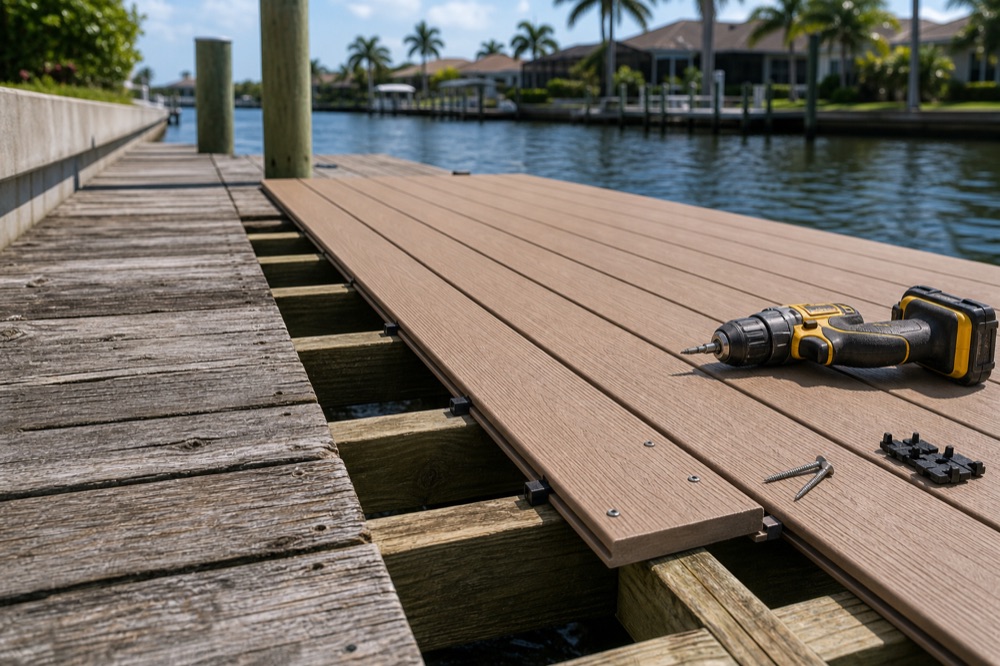
The trap is the cosmetic fix. New decking screwed onto old framing is the most common upgrade on this coast, it looks fantastic, and it does nothing for the part that’s actually failing. If the framing underneath is at the end of its life, you’ve just spent real money making it harder to see.
Repair or replace a dock in Florida walks through the decision honestly.
What we’d tell a neighbor
Push on your pilings once a season. Look at your lift cables, the whole length, twice a year. Watch your lawn behind the seawall for soft spots. Fix loose hardware when it’s loose rather than when it’s failed.
That’s most of it, and it’s the difference between a dock that gets maintained and a dock that gets replaced.
If something on yours has started moving, sounding different, or bleeding rust: we’ll come look and tell you honestly whether it’s a repair or something bigger. Free on-site estimate anywhere in Naples: (239) 397-3400.
The rest of our Naples library: permits, water, storms, and what we actually see on these docks.