
Boat Lifts in Naples: Canals, Depths & the Right Setup
Naples water isn't one kind of water. A lift that's right on a Royal Harbor canal is the wrong answer off Moorings Bay: here's how the address changes the setup.
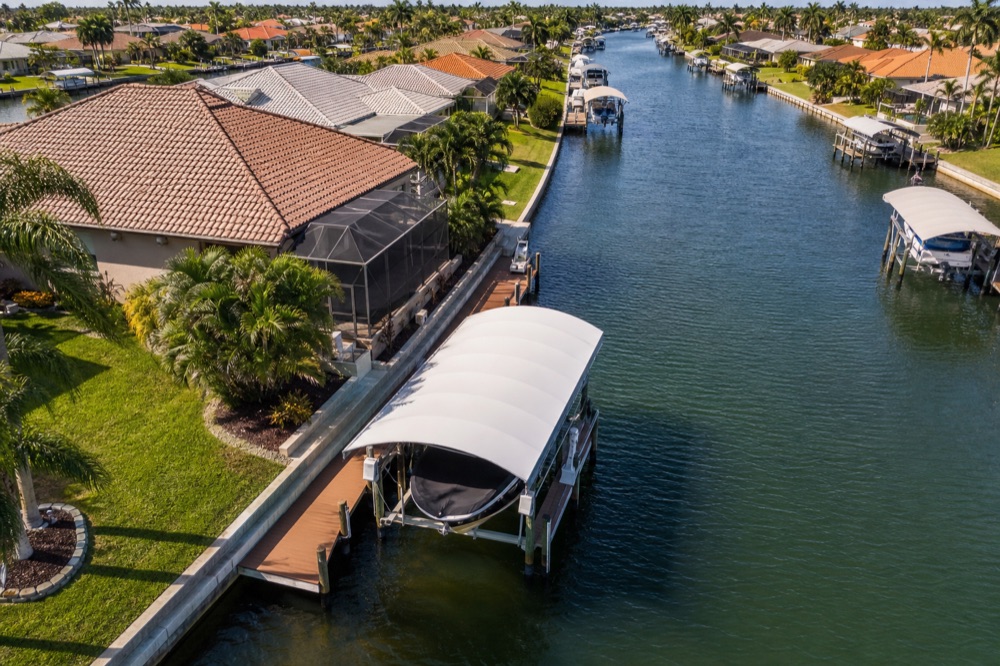
- Water character
- Naples Bay canals, the Doctors Pass bay system, and Gulf-access runs: genuinely different conditions
- What sizes it
- Loaded weight, not the brochure number: boat, fuel, water, and gear
- Capacity margin
- 20–30% over your loaded weight is the working guidance
- Permitting
- Handled in-house through the City of Naples or Collier County
Key takeaways
- Naples isn't one water. A protected finger canal off Naples Bay and an exposed run near open water ask for different setups.
- Size the lift to loaded weight: boat, fuel, water, gear, not the dry weight on the brochure, and carry 20–30% margin above it.
- Tide swing is the variable most owners underestimate, and it drives cradle style and lift height more than boat size does.
- Exposure decides how hard the salt and the chop work on the lift, which decides what materials are worth paying for.
- A canopy is a real cost and a real benefit: worth it for some owners, genuinely not for others.
“What lift do I need?” is a question with a Naples-specific answer, and not because of anything mystical about the city. It’s because Naples water genuinely varies, a lot: across a fairly small area.
The lift that’s right on a protected finger canal is not the lift that’s right on an exposed run near open water, and the boat you own is only about half the question.
What actually varies across Naples?
Three things, and they cut across neighborhoods rather than following them neatly.
Exposure. Some Naples addresses sit on short, protected canals where the water is almost always flat. Others sit on longer runs with real open water in front of them; Naples Bay itself, or the bays in the Doctors Pass system. The difference is fetch: how much open water the wind gets to build chop across before it reaches your boat. More fetch means more movement at the slip, more working of the hardware, and more reason to care about how the lift and boat are secured day to day.
Tide swing. This is the variable owners underestimate most consistently. A lift has to work across the whole range, and how much the water moves at your address influences cradle style, how the lift is set, and how usable it is at the bottom of the tide.
Depth at your slip at low water. Not the average depth, not the depth in the middle of the canal. The depth where the boat sits, at the bottom of the tide. That’s the constraint that decides whether a standard configuration works or whether you need something set up for shallow conditions.
Those three, plus your boat, are the whole conversation.
How do you size it correctly?
By loaded weight, and it’s worth being pedantic about this because getting it wrong is expensive.
The number on the brochure is dry weight. Your boat in the water is dry weight plus fuel, plus water, plus batteries, plus the engine’s fluids, plus every piece of gear that lives aboard, the anchor, the cooler, the tackle, the tubes, the stuff in the lockers. Fuel alone runs about 6 pounds per gallon, so a large tank is real weight before anything else goes on.
Then add margin. 20–30% above your loaded weight is the working guidance, and the reason is duty cycle rather than safety factor theatre: a lift running near its limit on every cycle wears its cables, motors, and connections harder than one with headroom. What size boat lift do I need does the arithmetic properly.
What setups actually come up here?
The mix on Naples water skews toward the boats the geography supports: center consoles and dual consoles that run out through the passes, cruisers and express boats on the deeper canals, pontoons and tritoons on the calmer protected water, and a lot of jet skis on secondary lifts.
That drives a few recurring answers:
| Situation | What usually fits |
|---|---|
| Protected canal, moderate boat | Standard four-post cradle lift |
| Pontoon or tritoon | Purpose-built pontoon configuration, not a standard cradle |
| Shallow at low tide | Configuration set for the low-water condition |
| Narrow canal, no room for a dock lift | Seawall-mounted, where the wall supports it |
| Jet skis alongside the main boat | Separate jet ski lift or a floating solution |
Types of boat lifts explained covers the categories, and pontoon and tritoon lifts covers the one that most often gets specified wrong.
What about materials?
Exposure decides this more than budget does.
Salt works on everything, everywhere in Naples, but a lift on an exposed run with regular chop is getting worked mechanically as well as chemically, and the fasteners, cables, and connections feel it. That’s the case where paying up on materials and hardware actually returns something. Aluminum versus galvanized in saltwater covers the real trade-offs, and zinc anodes and galvanic corrosion covers the maintenance side that quietly determines how long any of it lasts.
What does it cost?
Straight numbers, from our configurator:
- Jet ski lifts: $3,000–$5,000
- 7,000–10,000 lb: $8,000–$13,500
- 16,000 lb: $14,000–$19,000
- 24,000 lb and up, from $22,000
- Canopy: add $14,000–$22,000
What moves a project within those ranges is site-specific: whether you need new pilings or can use existing ones, how access works for the barge and crew, what the electrical run looks like, and what’s already on the dock. That’s why we quote on site, a number over the phone is a guess, and guesses in this business are always low.
Boat lift cost in Southwest Florida breaks the components down further.
Is a canopy worth it?
Genuinely depends, and we’ll give you both sides.
For it: sun and rain are what age a boat’s upholstery, canvas, electronics, and finishes. If the boat sits for stretches, and for a lot of Naples owners, particularly seasonal ones, it does, a canopy pays for itself in preserved condition and reduced cleaning.
Against it: it’s a significant cost, and it’s a large structure catching wind on the same pilings as everything else. In storm season that’s a real consideration, not a theoretical one.
Owners who run their boat several times a week often skip it. Owners whose boat sits between visits usually want it. Covered versus uncovered lifts goes deeper, and boathouse versus lift canopy covers the step up from there.
What about permitting and storms?
Both are handled elsewhere on this site, properly. Boat lift permits in Naples covers who reviews what, including the electrical scope, which is a licensed electrician’s work and not a place to improvise. Hurricane prep for Naples waterfront covers the seasonal side.
The one thing worth saying here: your lift’s storm position comes from its manufacturer, and your insurer may have requirements of its own. Both outrank general advice, including ours.
The honest summary
Bring us your boat’s loaded weight, your slip’s depth at low tide, and a sense of how exposed your stretch of water is. Those three things get you 80% of the way to the right lift. We’ll come measure the rest.
Free on-site estimate anywhere on Naples water: call (239) 397-3400.
The rest of our Naples library: permits, water, storms, and what we actually see on these docks.