
Buying Waterfront in Naples: Docks, Lifts & Seawalls to Inspect
A home inspection stops at the seawall. Everything past it is where the expensive surprises live, and where a buyer still has leverage.
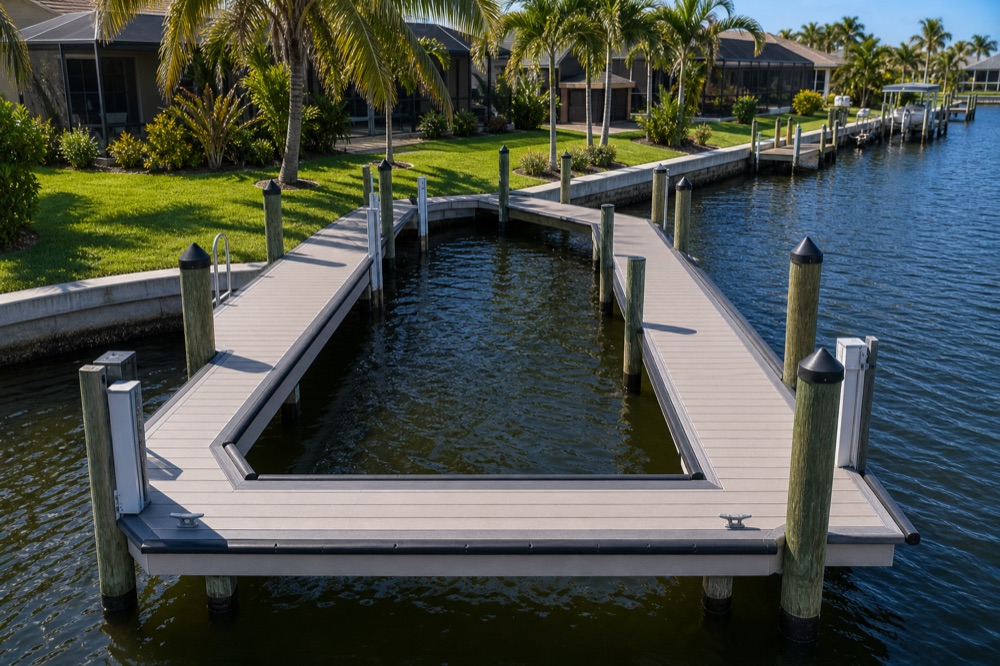
- Not in a home inspection
- Docks, lifts, seawalls, and pilings are usually outside the standard scope
- The expensive one
- The seawall. It hides its condition better than anything else on the lot
- The paperwork one
- Unpermitted work, which becomes yours at closing
- Best time to find out
- During diligence, while you still have leverage
Key takeaways
- A standard home inspection generally stops at the shoreline. The dock, lift, seawall, and pilings are usually outside its scope.
- The seawall is the highest-consequence unknown on a Naples waterfront lot and the best at hiding its condition.
- Ask for permits on every structure. 'It was here when we bought it' is not documentation, and the problem transfers to you.
- Walk the yard behind the seawall. Soft ground, dips, and small holes are the earliest honest signal you'll get.
- Everything you find during diligence is negotiable. Everything you find after closing is yours.
If you’re buying on the water in Naples, there’s a category of expense that most buyers never see coming, because the standard process is built to miss it.
A home inspection covers the house. It generally stops at the shoreline. And past that line sit the dock, the lift, the pilings, and the seawall: collectively one of the larger financial exposures on the property, and the one nobody’s contract requires anyone to look at.
Why is this the blind spot?
Because marine structures are outside most residential inspectors’ scope, and because they hide their condition unusually well.
A roof looks like a roof. A seawall in serious trouble and a seawall in perfect shape look almost identical from the lawn, because the parts that fail, the tiebacks behind it and the toe below it: are invisible. A dock with new decking screwed onto twenty-year-old framing looks better than a dock with old boards on sound framing.
The result is that the marine side of a waterfront purchase gets evaluated by eye, at a showing, in good weather. That’s not diligence.
What should you actually look at?
Work in this order, because it’s roughly the order of consequence.
The seawall
The highest-stakes item on the lot, and the best at hiding.
Walk the yard first. Not the wall, the ground behind it. New or settling holes, soft or spongy spots, sunken pavers, or a dip forming along the wall line all mean soil is escaping through or under the wall. That’s how walls fail here, and the lawn tells you before the concrete does. Erosion behind a seawall shows what it looks like as it progresses.
Then the wall. Cap cracks, especially ones that have opened or widened. Gaps between panels. Weep holes that are blocked, or that are discharging sediment rather than water. And sight the whole wall from a corner of the lot: any section out of line with its neighbors means movement.
What you can’t see is what matters most: the tiebacks and the toe. Signs your seawall is failing covers the full list, and our Naples seawall guide covers how walls fail on this coast specifically.
Why this ranks first: a seawall replacement is a large, permitted project, and in the City of Naples it requires engineered plans sealed by a registered professional, which is a design phase before a construction phase. It is not a thing you absorb casually after closing.
The pilings
The foundation of everything on the water.
Push on them. Look for movement. Compare the waterline growth and staining across the row, a piling whose line sits higher or lower than its neighbors has moved vertically, which is a serious finding. Look at the wood itself at and below the waterline for softness, boring, or damage.
How long dock pilings last in saltwater sets expectations, and marine borers covers the failure mode that does its work out of sight.
The dock structure
Connections over cosmetics, always.
Every place framing meets a piling is a place to look for gaps, crushed wood, corroded or backed-out fasteners, and elongated bolt holes. Then look at the framing itself, not just the decking, because new decking over tired framing is the single most common cosmetic-upgrade-before-sale on this coast, and it reads beautifully in photos.
Repair or replace a dock covers how that call gets made once you know what you’ve got.
The lift
The one with a service life you can actually estimate.
Cables are the tell: look along their whole length, not just what’s visible from the deck. Fraying, rust bleed, flat spots, or broken strands are replacement signals. Cable replacement warning signs covers what to look for.
Then: does it run? Ask to see it cycle, fully, up and down, with the seller present. A lift that hasn’t been operated in months and won’t be demonstrated is a question, not an amenity.
Also worth knowing: the lift’s capacity versus the boat you intend to keep there. A lift sized for the seller’s boat is not automatically sized for yours, and capacity is about loaded weight with 20–30% margin.
What about the paperwork?
Ask for permits on every structure: dock, lift, seawall, tiki hut. All of them.
“It was here when we bought it” is not documentation. It’s an unanswered question, and at closing it becomes your unanswered question. Unpermitted work can require after-the-fact permitting, modification, or removal, and you’ll be handling it on your budget and timeline rather than the seller’s.
The reason this matters more than it sounds: it doesn’t go away, it waits. The next buyer’s diligence will find it too, and you’ll be having this same conversation from the other side of the table. Unpermitted dock and seawall work when buying or selling covers how it typically plays out.
What about the water itself?
Two questions that change what the property is worth to you specifically.
Depth at the slip at the bottom of the tide, not the middle of the canal on a nice afternoon. This determines what boat you can actually keep, which is often the reason someone is buying waterfront in the first place. Measure it, or have it measured.
Which pass you’d use and whether your boat suits it. Gordon Pass and Doctors Pass are genuinely different, and Doctors Pass is narrower and shallower. If you’re buying on the northern bays with a boat that draws real water, that’s a conversation to have before closing, not after.
Where’s the leverage?
In diligence. Only in diligence.
Everything you find before closing is a negotiation, a credit, a price adjustment, a seller repair, or a walk-away. Everything you find after closing is a project you own.
That asymmetry is the entire argument for having someone look at the marine structures during your inspection period. It’s a short visit against a purchase this size, and it either buys you peace of mind or it buys you a number to negotiate with.
We do pre-purchase looks at docks, lifts, seawalls, and pilings across Naples, and we’ll tell you plainly what we see, including when the honest answer is “this is in good shape.” Call (239) 397-3400.
The rest of our Naples library: permits, water, storms, and what we actually see on these docks.