
Seawalls & Shorelines in Naples: What Holds Up Here
Concrete, vinyl, rock, or some combination: what actually survives on Naples water, and why the answer changes between a sheltered canal and an exposed bay edge.
- What you'll see
- Concrete and vinyl walls, with rip-rap increasingly used at the toe
- What fails first
- Tiebacks, weep holes, and the toe: rarely the wall face itself
- The early warning
- Your yard, not your wall: soft spots and small holes come first
- Permitting
- Required, and Naples wants engineered plans
Key takeaways
- Seawalls here almost never fail at the face. They fail at the tiebacks, at the weep holes, and at the toe.
- The first symptom shows up in your yard, a soft spot, a dip, a small hole, not on the wall itself.
- Exposure decides the right answer. A sheltered canal and an open bay edge are different engineering problems.
- Rip-rap at the toe is the most direct defense against scour there is, and it pairs with a wall rather than replacing it.
- Every seawall on this coast is on a clock. The question is whether you're managing it or discovering it.
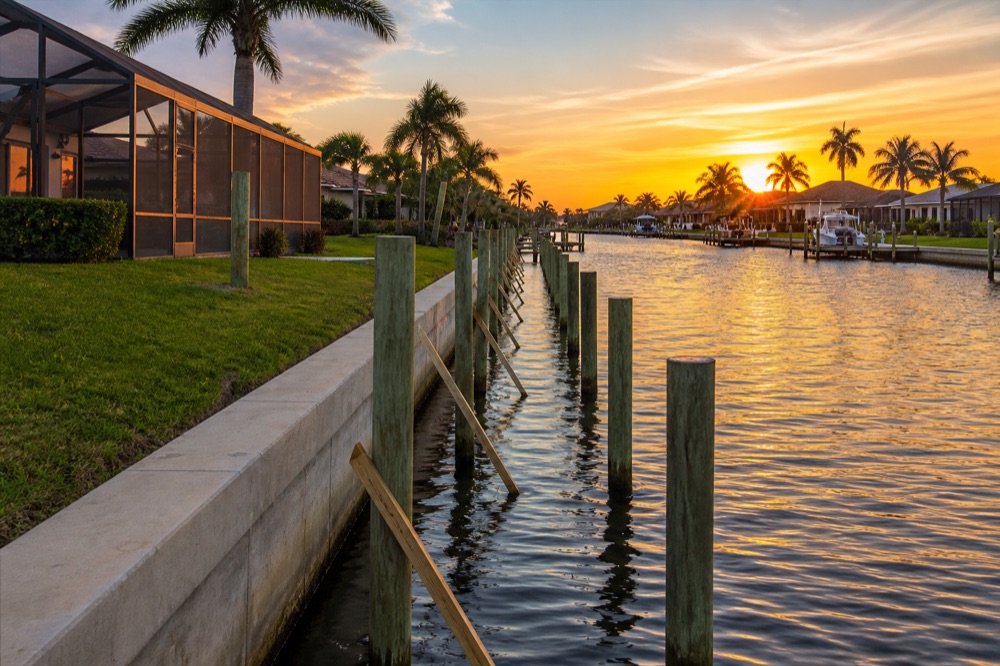
Drive any Naples canal and you’ll see the same thing over and over: a clean line of concrete or vinyl separating a lawn from the water, running property to property with barely a gap. It looks permanent.
It isn’t. Every one of those walls is on a clock, and the useful question for an owner is whether you’re managing that clock or waiting to discover it.
What does a seawall actually do here?
It holds your yard up. That’s the whole job: retaining the soil of your lot against the water, the tide, and the pressure of saturated ground behind it.
It’s worth being precise about that, because owners often expect a second job the wall was never built for. A seawall is not a flood barrier and it will not keep storm water out of your yard. We wrote a whole page on why surge goes over walls because the misunderstanding leads people to spend money on the wrong thing.
What holds up on Naples water?
Both of the common materials work when they’re designed and installed correctly, and both fail when they aren’t.
Concrete is what you’ll see on most of the older Naples waterfront. Substantial, heavy, long-lived when the reinforcement stays protected. Its enemy is water getting to steel, which is why cap condition and joint integrity matter so much.
Vinyl shows up more on newer construction and replacements. Lighter, doesn’t corrode, and the panels themselves are essentially immune to the chemistry that attacks concrete. Its performance still depends entirely on the parts that aren’t vinyl, the tiebacks, the cap, the anchoring system.
We compare them properly in vinyl versus concrete seawall, and vinyl versus concrete versus rip-rap brings rock into the comparison.
But here’s the thing worth internalizing: the material is not usually what decides how long a wall lasts. The tiebacks, the drainage, and the toe are.
How do seawalls actually fail?
Three ways, in roughly this order of frequency, and none of them is “the wall face broke.”
Tiebacks corrode through. Behind every wall is a system of rods and buried anchors: deadmen: holding it back against the soil pressure. They’re steel, they’re buried in wet ground, and they’re doing all the structural work nobody can see. When they go, the wall starts to rotate outward, and you get a lean or a bow. Tieback and deadman anchor failure covers what that looks like.
Weep holes clog. Those small openings exist so water can drain out through the wall instead of stacking up behind it. Saturated soil is dramatically heavier and pushes harder; when the drainage stops working, the wall takes a load it wasn’t designed to carry every time it rains hard. Clogged weep holes is one of the most preventable failures on this list.
The toe scours out. Moving water carries sand away from the base of the wall: exactly where it needs confinement. Storms accelerate it dramatically, but tide and wake do it slowly all year. The wall is unchanged; the material supporting it is gone.
Where does the first symptom show up?
Your yard. Not your wall.
This is the single most useful thing on this page. Soil escaping through or under a wall shows up as a soft spot, a dip along the seawall line, a sunken paver, or a small hole: long before the wall itself looks like anything is wrong. By the time the wall is visibly leaning, you’re well into the problem.
So the Naples homeowner’s seawall check is a walk across the lawn, not a look at the concrete. Signs your seawall is failing covers the full list, and erosion behind a seawall covers what it looks like when it’s advanced.
Does exposure change the right answer?
Substantially, and this is where a Naples-specific answer earns its keep.
A wall on a short, protected finger canal lives an easy life. Small chop, limited fetch, modest wake. A wall along a longer open run, or facing one of the broader bays in the Doctors Pass system: takes wave energy all year, and that changes the calculation on toe protection, on cap detailing, and on how often the whole thing should be looked at.
The Naples canal and water guide covers how the local geography sorts into those categories. The short version for seawall purposes: know how much open water sits in front of you, because that number drives everything about how hard your wall is working.
Where does rip-rap fit?
Mostly at the toe, and it’s the most direct answer to scour available.
Rock placed at the base of a wall absorbs wave energy before it reaches the wall and keeps moving water from carrying sand out from underneath. It’s not decorative and it’s not a hedge. It addresses the specific failure mode that undermines walls on this coast. Rip-rap to protect a failing seawall toe covers when it’s the right call.
As a primary shoreline treatment rather than a wall, it depends on your lot. Rock needs horizontal room to slope properly, and plenty of Naples lots don’t have it to spare. Where there is room, it’s a genuinely good shoreline that also happens to be better habitat than a vertical wall.
What about lifts and docks on the wall?
Common question on the narrower Naples canals, where there isn’t room for a conventional dock-mounted lift.
Sometimes yes, but understand what you’re asking. A seawall is engineered to retain soil under a steady load. Mounting a lift adds a cyclical load, applied repeatedly, from a different direction. Whether your wall can take that depends on its construction and its current condition, and it’s a question that genuinely requires someone looking at the wall. Boat lift on a seawall with no dock covers when it works.
What’s the maintenance that actually matters?
Short list, and it’s all unglamorous:
- Keep weep holes clear and functioning. Cheapest structural insurance available.
- Watch the cap for new or widening cracks, and seal what should be sealed before water finds the steel.
- Watch your yard, seasonally. Soft spots and dips are the early warning system.
- Protect the toe if you have exposure or have seen scour.
- Clean it; how to clean a seawall, because growth and staining hide the cracks you’re trying to spot.
What about permitting?
Seawall work in Naples is permitted work, and the city requires engineered plans sealed by a Florida-registered professional engineer or architect. That’s a design phase before a permit phase, and it’s a real schedule and budget item. Seawall permits in Naples covers the full picture.
Which is the practical argument for not waiting: a small repair permits and builds on your calendar. A failure permits and builds on the wall’s.
If you’ve seen a soft spot in the lawn, a crack that’s opened up, or a section that’s out of line with its neighbors, that’s the moment a look is worth the most. Free on-site estimate: (239) 397-3400.
The rest of our Naples library: permits, water, storms, and what we actually see on these docks.